Social media for plumbers has become an essential component of the digital marketing ecosystem. Homeowners now spend significant time on video and social platforms before calling a plumber, which means a plumbing company without a presence on those platforms is invisible during that research window.
A large majority of local business searches still start on Google, but roughly 39% of recent local searches began somewhere other than Google, including social media, AI tools, and review sites, according to BrightLocal’s 2026 consumer search behavior research.
For a plumbing company, that means a share of potential customers are forming an impression of the business before a Google search ever happens.
The practical opportunity cost is straightforward. A plumbing company absent from the platforms its customers use daily cedes that research window to competitors who are present.
This doesn’t require being active on every platform. It requires being deliberate about which one or two platforms match the audience and the available time.
The following guide outlines the importance of social media for plumbers and how to best integrate a social media marketing strategy into your broader digital marketing campaign.
Key Takeaways
- YouTube (84%) and Facebook (71%) reach the largest share of U.S. adults, making them the default starting platforms for most plumbing companies.
- Instagram (50%) and TikTok (37%) are the strongest video-first platforms for reaching younger homeowners.
- Google’s own documentation does not list social engagement (likes, shares, followers) as a search ranking signal. Social media supports SEO indirectly, through traffic and brand search, not directly through rankings.
- Solo operators and single-truck businesses should prioritize one or two platforms and organic content before considering paid ads.
- The most common failure mode isn’t picking the wrong platform. It’s treating social media as a lead-gen channel before the account has an audience.
Social Media’s Impact on Google Rankings
Google’s own ranking systems documentation does not include social media engagement (likes, shares, follower counts) among the signals and systems used to rank web pages.
Social media supports search visibility indirectly: content that performs well on social platforms is more likely to earn links, generate branded searches, and drive traffic, all of which Google’s documented systems do account for.
A plumbing company should not expect a social media post to directly improve its Google rankings, but an active, well-linked social presence can support the broader signals that do.
Customer Engagement on Social Media
Existing plumbing customers spend time on the same platforms as prospective ones, and they increasingly expect to reach a business there. It’s common for a customer to direct-message a plumbing company through Facebook or Instagram to ask about scheduling or clarify a service, rather than calling or emailing.
Plumbers should also expect that some customers will use social platforms to post about a bad experience, which makes monitoring and responding to comments a practical necessity, not an optional extra.
Building Industry Influence Through Social Media
A plumbing company that maintains an active social presence can expand its visibility within its service area more quickly than one relying on organic search alone.
Sharing testimonials from satisfied customers and responding to comments and messages shape how prospective customers perceive the brand before they’ve had any direct interaction with it.
Spreading that activity across two or three platforms, rather than concentrating it entirely on one, reduces the business’s exposure to a single platform’s algorithm changes.
Reaching Plumbing Customers on Social Media
Plumbers can attempt to reach customers on social media through organic or paid content.
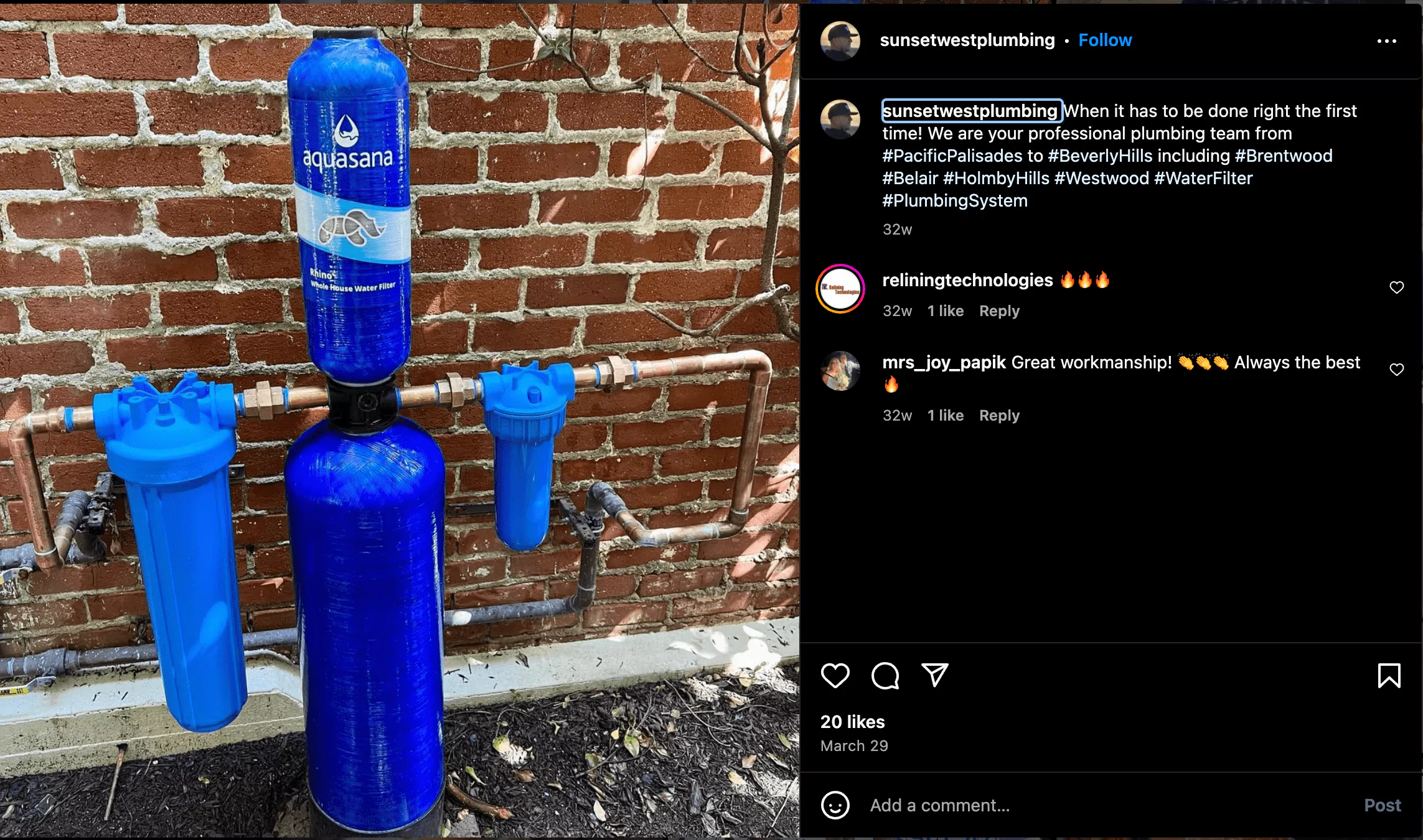
Organic content costs nothing to post but reaches a limited audience, especially for a new or low-follower account. Customer reviews, job-site photos, and short videos are the most accessible organic formats for a plumbing company with no dedicated marketing staff.
Limited early engagement is normal and doesn’t indicate the content is failing. Existing customers are more likely to notice and share this content than strangers are.
Paid social advertising, primarily through Meta ads on Facebook and Instagram, expands reach well beyond what organic posting can achieve, but it requires a real budget and a willingness to test before scaling spend.
A plumbing company that runs ads without first understanding cost-per-lead and campaign optimization risks spending money with no way to evaluate whether it’s working.
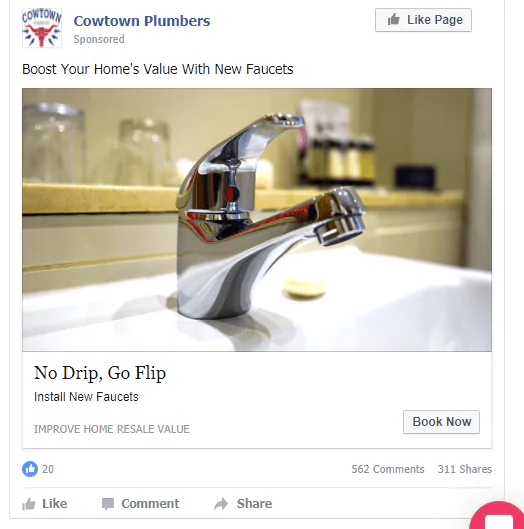
Based on Plumbing Webmasters’ client campaigns, plumbing companies that see the strongest early results from paid social are ones that start with a single, narrowly targeted campaign (one service, one service area) rather than a broad brand-awareness push.
When Paid Social Ads Don’t Make Sense
Paid social advertising isn’t the right starting point for every plumbing business. A solo operator or single-truck company with no existing organic presence is usually better served by spending a few months building an organic following first, since paid ads sending traffic to an inactive, low-trust profile tend to underperform.
Ad spend also doesn’t make sense for a business that can’t currently handle additional lead volume. Paid social works best once a business has organic proof of concept (an active profile, some reviews, some engagement) and enough capacity to follow up on the leads ads generate.
Comparing Social Media Platforms for Plumbers
The table below shows current U.S. adult platform adoption, based on the Pew Research Center’s 2025 Social Media Fact Sheet. LinkedIn and Pinterest were not included in Pew’s 2025 survey wave, so those two figures are one year older (2024) than the rest.
| Platform | % of U.S. Adults (as of 2025) | Best Use Case for Plumbers | Lead Potential |
|---|---|---|---|
| YouTube | 84% | Long-form and short-form job videos, tutorials | Moderate (builds trust, drives search traffic) |
| 71% | Reviews, community groups, local visibility | Highest of the free platforms | |
| 50% | Photos, Reels, visual before/after content | Moderate, strong for brand awareness | |
| TikTok | 37% | Short-form video, behind-the-scenes content | Growing, best for younger homeowner segments |
| LinkedIn (2024 data) | 32% | Business page and owner profile for credibility signals | Low direct lead generation |
| Pinterest (2024 data) | 36% | Visual project photos, linkable pins | Low, but supports brand visibility |
| X (formerly Twitter) | 21% | Real-time updates, not evergreen content | Low, mainly reputation monitoring |
Facebook and Instagram, both run through Meta’s advertising platform, are generally the strongest starting point for a plumbing company with limited time, since they combine the largest reach with the most mature local-business ad tools.
LinkedIn and Pinterest are lower-priority for lead generation but still worth a basic, consistent presence for brand visibility and search-adjacent signals.
TikTok and YouTube both reward video content, but they suit different production styles. YouTube favors longer-form content (full job walkthroughs, multi-minute tutorials) alongside Shorts, and its content tends to stay discoverable through search long after posting, since YouTube videos frequently surface in Google search results.
TikTok favors short, fast-paced clips and rewards frequent posting over production polish, which makes it a better fit for a plumber comfortable filming quick phone videos on the job rather than editing longer content. A plumbing company with limited time is generally better served by choosing one of the two rather than splitting effort between them.
Creating Social Content That Performs
Video content should be the top priority for most plumbing social accounts, since shorter attention spans reward quick, visual content over long text posts. Job walkthroughs, short tutorials, and behind-the-scenes clips work well on YouTube, Instagram, and TikTok specifically, where users are accustomed to scrolling through short-form video.
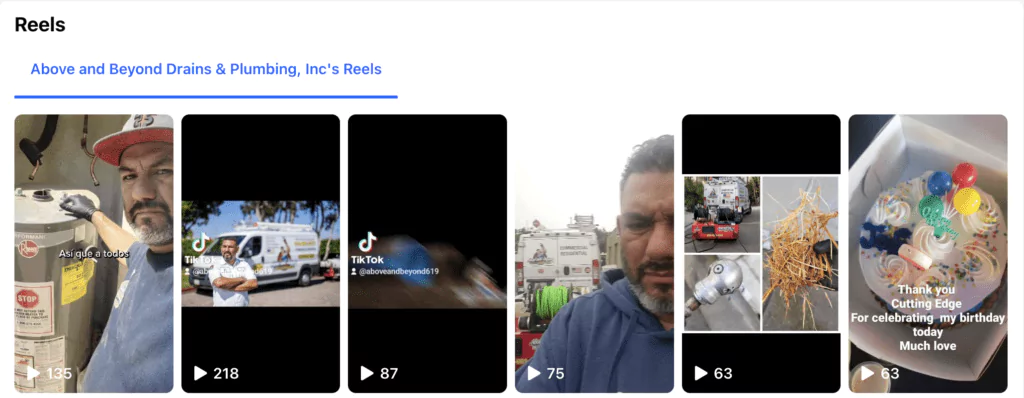
Client testimonials convert well because they let a prospective customer see evidence of a good experience rather than taking the business’s word for it. Turning written Google or Yelp reviews into simple graphics and sharing occasional video testimonials from repeat customers gives a plumbing company a steady stream of content that doesn’t require original production each time.
Native, platform-specific posts outperform generic cross-posted content. A photo of the team at a company event fits Instagram’s native style; a plain-language breakdown of showerhead types for homeowners fits better on Facebook or X, where longer-form text is more common.
Promotional posts work best sparingly. Posting too many discounts or offers outside paid ads can reduce organic visibility in platform algorithms, so promotional content should be a small fraction of an account’s overall posting mix, with a clear, time-bound call to action when it does appear.
When Social Media Underperforms for Plumbers
Social media underperforms for plumbing companies under a few predictable conditions:
Expecting social media to substitute for local SEO. Social platforms support brand visibility and customer engagement, but they are not a replacement for a well-optimized Google Business Profile and website.
Posting inconsistently, then stopping. An account that posts weekly for a month and then goes silent for three loses whatever early momentum it built. Consistency matters more than volume.
Running paid ads before organic proof of concept exists. Ads sending traffic to an inactive or low-trust profile tend to convert poorly.
Treating every platform the same way. Content built for Instagram rarely performs as well when copy-pasted directly to X or LinkedIn without adjusting for format and audience.
Over-promoting. Accounts that post discounts and offers too frequently see reduced organic reach from platform algorithms.
Ignoring comments and messages. Customers increasingly expect a response through the same platform they used to reach out, and an unanswered message reads as unresponsive.
Social Media Tactics for Solo and Small-Team Plumbers
A single-truck plumbing business without marketing staff doesn’t need to replicate a full-agency strategy. Below is a workable starting approach:
- Pick one or two platforms, based on the table above, rather than attempting a presence everywhere at once.
- Post consistently, even if that means once or twice a week rather than daily.
- Use existing material. Job-site photos and short phone-recorded videos require no separate production budget.
- Join local Facebook Groups and, where available, Nextdoor, and participate without immediately promoting the business. Community platforms like Nextdoor reward genuine, non-promotional participation over direct advertising.
- Hold off on paid ads until organic content has built some baseline engagement and reviews.
- Use a free design tool like Canva to turn written reviews into simple, shareable graphics without hiring a designer.
Cost is often the deciding factor for a solo operator, and the honest answer is that organic social media has no direct cost beyond time. The cost question only becomes relevant once a business considers paid ads, and at that point, the right first move is a small, capped test budget on a single campaign rather than a large upfront commitment.
A business that isn’t ready to track cost-per-lead and adjust a campaign accordingly isn’t ready to spend meaningfully on paid social yet, regardless of budget size.
Getting Started With Your Plumbing Social Media Campaign
A plumbing company building its social media presence for the first time doesn’t need to be active on every platform immediately. Choosing one or two platforms where the target audience actually spends time, posting consistently, and holding off on paid advertising until there’s an organic foundation to build on will yield better early results than attempting to be present on every platform at once.
At Plumbing Webmasters, our work with local plumbing clients has consistently shown that a focused, sustained presence on one or two platforms outperforms a scattered presence across all of them.

Author: Nolen Walker
Nolen Walker is the founder of Plumbing Webmasters and the creator of DataPins™, a Local SEO platform for plumbing companies. He has over 16 years of experience helping plumbing businesses grow through organic search, Google Maps, and AI-driven visibility.
Nolen is the author of A Complete SEO Guide for the Plumbing Small Business Owner. He also hosts The Plumbing SEO Podcast on Spotify.