
Facebook Ads, sometimes referred to as Meta Ads, are advertisements that appear in the Facebook News Feed, Instagram, and other placement areas on mobile and desktop, built around a specific campaign objective such as awareness, engagement, or lead generation.
Plumbing companies run these ads through Meta Business Suite, which manages advertising across both Facebook and Instagram from a single dashboard.
The following guide from Plumbing Webmasters outlines the benefits of Facebook Ads for plumbing companies, along with best practices for maximizing performance and cases where running ads is not recommended.
Key Takeaways
- Facebook (Meta) lead campaigns averaged $27.66 per lead in 2025, a cross-industry blended figure that ranged from $3.16 to $76.71 depending on category. Local, appointment-driven services like plumbing likely sit above the blended average.
- Facebook’s lead costs run well below Google Ads’ $70.11 average cost per lead, though the two platforms capture different search intent.
- Five ad formats are available to plumbers: Image, Video, Carousel, Instant Experience, and Collection, each suited to a different objective.
- Meta’s Advantage+ targeting is effective for most plumbing accounts, but it is not automatically superior to manual targeting in every case.
- Facebook Ads work best for planned, non-emergency plumbing work. Homeowners searching for urgent repairs still lean toward Google.
Facebook Ads Cost for Plumbers
Facebook ad costs depend heavily on campaign type. Traffic campaigns averaged a $0.70 cost per click in 2025, down 6.7% year over year. Lead generation campaigns, which are the format most plumbers use to capture new customers, averaged a $1.92 cost per click and a $27.66 cost per lead, up 21% year over year.
This $27.66 figure is a cross-industry average, not a plumbing-specific benchmark. In the same report, lead-campaign CPL ranged from $3.16 in low-consideration categories like restaurants to $76.71 in high-consideration, appointment-based categories like dental services.
Plumbing wasn’t broken out separately, but it shares more in common with the high end of that range (local competition, appointment-based conversion, higher-ticket jobs) than with the low end, so plan your budget assuming a CPL meaningfully above $27.66 rather than at it.
Expert Analysis
Plumbers can invest in Facebook Lead Ads to acquire new local customers, though the $27.66 average cost per lead reported across industries is a floor to plan above, not a plumbing-specific target.
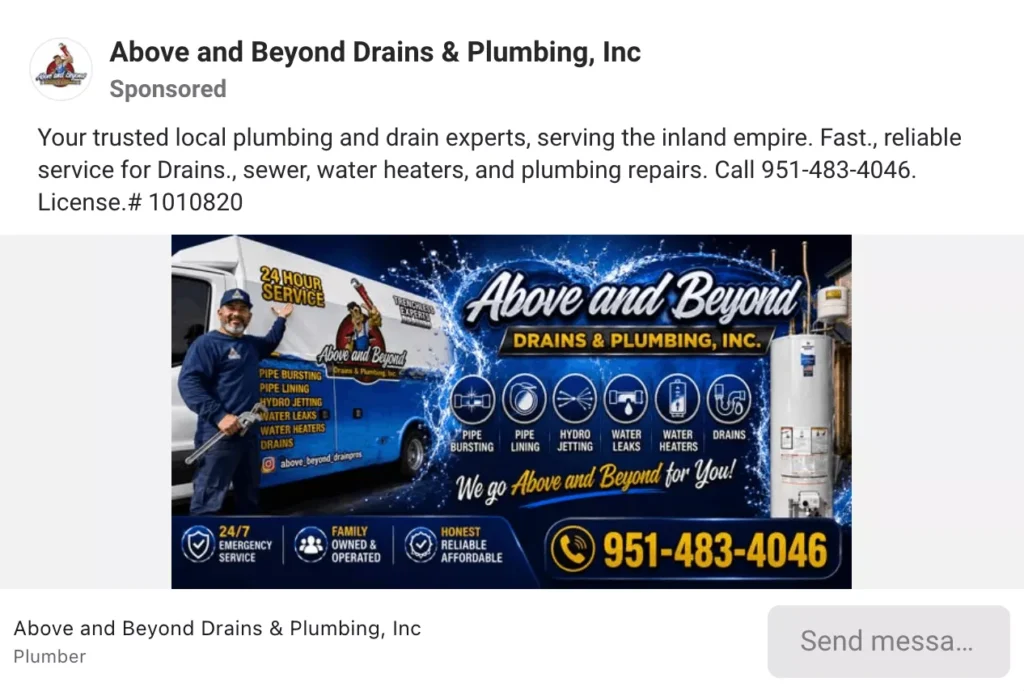
Facebook Ads Examples
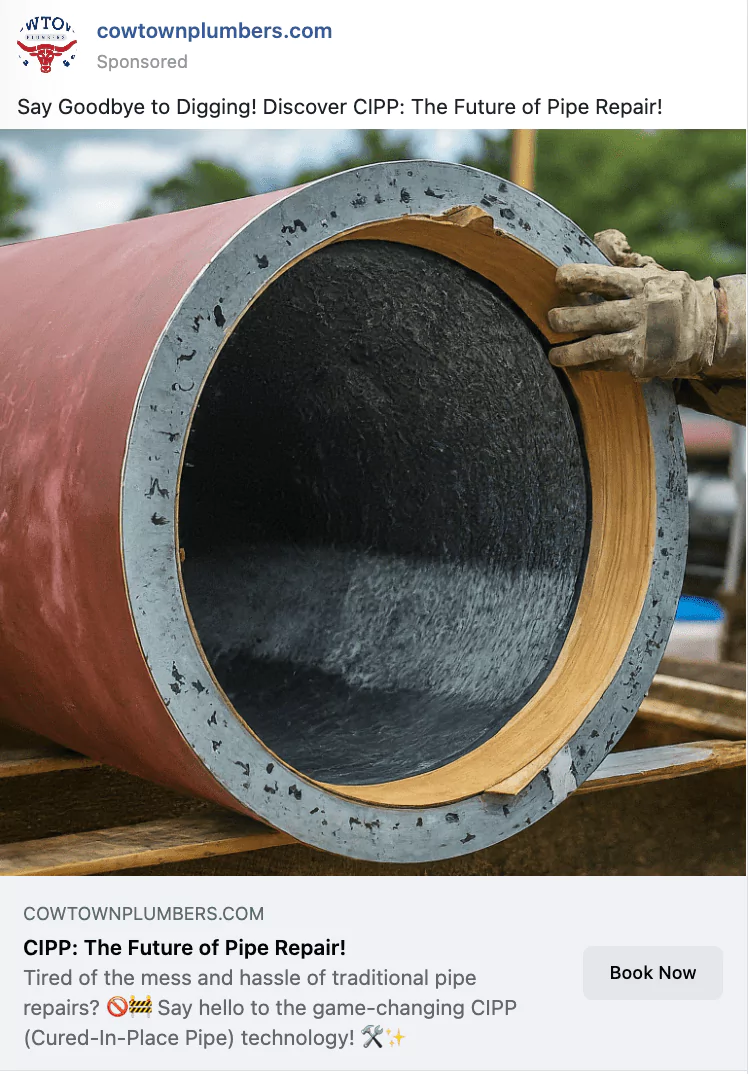
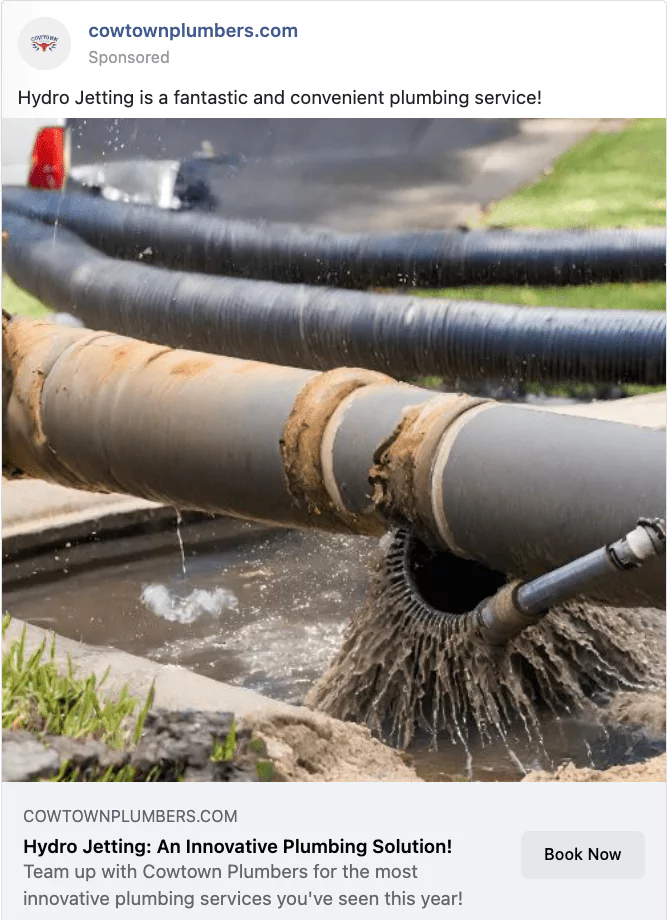
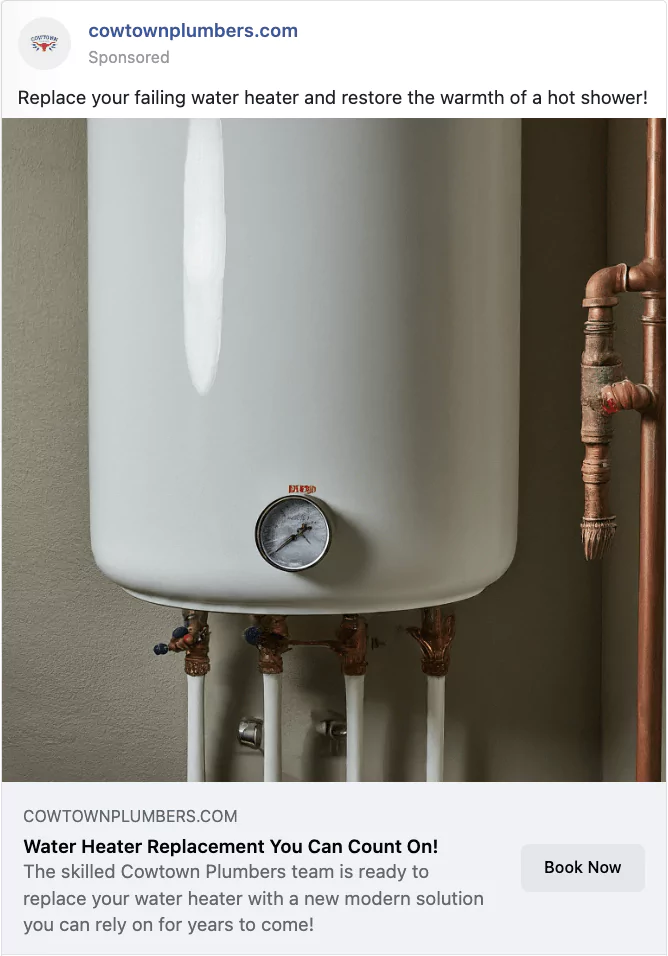
Below are some ad examples from plumbing campaigns.
Types of Facebook Ads for Plumbers
| Ad Type | Best Use Case | Notes |
|---|---|---|
| Image | Showcasing a specific service quickly | Branded images featuring your team and staff generate the most engagement and clicks. |
| Video | Building trust through your team in action | Include audio and subtitles for the strongest results. |
| Carousel | Promoting multiple service types in one ad | Supports up to 10 photos or videos, each with its own link. |
| Instant Experience | Capturing attention with an immersive mobile ad | Formerly Canvas ads; combines video, photos, and carousels in a single unit. |
| Collection | Product-based sales | Rarely relevant for plumbers, since most plumbing services aren’t sold as discrete products. |
Cost figures are cross-industry averages from the same 2025 benchmark report, not plumbing-specific. Local, appointment-based trades typically run above the all-industry average shown here.
Facebook Ads vs. Google Ads for Plumbers
Homeowners searching Google for a plumber are typically already in need of a service. Homeowners scrolling Facebook are not actively searching, which makes Meta better suited to planned work (water heater replacements, repiping, maintenance plans) than to emergency calls.
| Meta (Facebook) Ads | Google Ads | |
|---|---|---|
| Buyer intent | Passive; interrupts browsing | Active; user is already searching |
| Avg. cost per lead (2025) | $27.66 | $70.11 |
| Best fit | Planned, non-emergency services | Emergency and same-day service calls |
| Format strength | Visual storytelling, before/after content | Text ads matched to search terms |
When this doesn’t apply: If your plumbing business relies primarily on emergency and same-day calls, Google Ads and Google Local Services Ads (a separate, pay-per-lead product from standard Google Ads) typically deserve a larger share of budget than Meta. Meta performs best as a complement to search advertising, not a replacement for it.
Facebook Advertising Objectives for Plumbers
Before creating an ad, plumbers need to choose an objective that matches the action they want a user to take.
Awareness objectives build interest in your plumbing services. A plumber expanding into a nearby town might run an awareness campaign to introduce the brand to new local homeowners before ever asking for a click or a call.
Consideration objectives move users toward engaging with your brand, such as visiting your website. A plumber launching a new plumbing website might run a traffic campaign to drive visitors there and let on-site conversion elements do the rest.
Conversion objectives are built for direct action, such as a lead form submission or booking request. These typically follow awareness and consideration campaigns rather than replacing them.
When this doesn’t apply: A brand-new plumbing business with no ad history usually gets more value from awareness and consideration objectives first. An established plumbing company with a strong list of past customers can move directly into conversion campaigns, since the audience already recognizes the brand.
Facebook Lead Ads for Plumbing Companies
Some plumbers want to convert new customers directly on Facebook rather than sending them to a website. Facebook Lead Ads solve this by pre-filling the lead form with the user’s name, phone number, and other information already on file with Meta, so more people complete the submission.
Mobile Consideration
Submitting forms on mobile is a common point of drop-off. Meta’s pre-filled mobile forms remove one of the biggest causes of abandoned submissions.
Audience Targeting
Not every homeowner needs your plumbing services. Spending your ad budget on the right audience concentrates lead generation on the people most likely to become customers.
Meta’s Advantage+ audience targeting uses AI to optimize ad delivery toward the audience most likely to convert, and it performs well for most plumbing accounts with enough conversion data to train on.
That said, platform-reported performance and “the algorithm needs more time to learn” framing warrant a closer look than blind trust, particularly for newer accounts still building a conversion history.
Meta offers a middle path: campaign managers can list specific interests, such as “homeownership” or “home improvement,” as suggestions that help direct the Advantage+ algorithm rather than overriding it entirely.
When this doesn’t apply: A solo plumbing operator with a small ad budget and limited historical conversion data may see more consistent results layering in manual interest targeting rather than relying on Advantage+ alone, since the algorithm has less data to optimize against.
Survey Application
Custom forms qualify leads further, filtering out false leads and spam so ad spend goes toward genuine opportunities.
CRM Integration
Send plumbing leads directly to your third-party CRM to complete your standard sales process with each prospect.
Facebook Ad Budget for Plumbing Businesses
Your budget controls how much you spend on ads for a specific ad set or campaign. You can set an overall campaign budget or assign funds to individual ad sets.
Meta’s built-in Campaign Budget Optimization (CBO) tool automatically manages your budget in real time if you use it.
Campaign Budgets utilize CBO by default, automatically optimizing your campaign budget in real time. This lets advertisers focus on other areas while the algorithm handles budget management.
Ad Set Budgets give plumbers specific control over each ad set individually. Manual ad-set budgeting gives advertisers more control, at the cost of more manual work, and can help companies with dynamic objectives that shift by service or season.
Daily Budgets define what you spend per day on a set or campaign. Daily budgets often work best for consistent, predictable results and eliminate the complication of distributing separate fund amounts each day. Keep in mind that daily budgets have no hard cap.
Lifetime Budgets define what you spend across a campaign or ad set’s entire span. Unlike daily budgets, lifetime budgets have a hard cap, which makes them a better fit when you can’t exceed a specific total. Daily spending will still vary within that cap.
Quick tips:
- Choose a campaign budget with CBO if you want Meta’s algorithm to manage allocation automatically.
- Choose ad set budgets if you’re running multiple service lines and want manual control over each.
- Choose a daily budget if you want predictable, ongoing spend with no fixed end date.
- Choose a lifetime budget if you’re running a fixed promotion and need a hard spending cap.
When Facebook Ads Don’t Work for Plumbers
Facebook Ads aren’t a fit for every plumbing business or every moment in the customer’s decision. Based on analysis of client accounts, a few patterns show up consistently:
Emergency-driven service areas. Homeowners with a burst pipe or an active leak search Google, not Facebook. Meta campaigns built around emergency messaging tend to underperform search-based channels for that specific intent, even when the creative and targeting are well built.
Creative fatigue. The same ad shown repeatedly to the same audience loses effectiveness over time. Plumbers running a single ad for months without refreshing the creative typically see rising costs and falling engagement, independent of anything wrong with the targeting.
Underperformance blamed on “the algorithm needing more time.” This explanation is sometimes accurate and sometimes a way to avoid examining the offer, creative, or landing page. Before extending a campaign’s learning phase, check whether the ad itself gives a homeowner a clear, specific reason to act.
Seasonal mismatches. A campaign promoting drain cleaning in the dead of winter, when frozen pipe searches dominate demand, will generally underperform a campaign timed to the season’s actual concerns.
None of this means Facebook Ads don’t work for plumbers. It means Facebook Ads work for a specific kind of demand (planned, non-emergency, brand-building), and expecting them to perform like a search platform built for active, urgent intent sets the wrong benchmark.
Get the Most Out of Your Facebook Ads
Meta’s advertising business is enormous: the company generated $196.17 billion in advertising revenue last year, a 22.1% year-over-year increase. That scale has only increased advertiser demand.
Plumbers competing for the attention of Meta users need creative and offers specific enough to earn engagement against every other advertiser bidding for the same homeowner.
Examples of this might include:
- “$50 Off Water Heater Inspections & Tune-Ups”
- “Free Camera Inspection with Drain Cleaning”
- “Before & After: Complete Tankless Water Heater Installation”
Plumbers who treat Facebook as a complement to search advertising, rather than a replacement for it, tend to see the most consistent results.

Author: Nolen Walker
Nolen Walker is the founder of Plumbing Webmasters and the creator of DataPins™, a Local SEO platform for plumbing companies. He has over 16 years of experience helping plumbing businesses grow through organic search, Google Maps, and AI-driven visibility.
Nolen is the author of A Complete SEO Guide for the Plumbing Small Business Owner. He also hosts The Plumbing SEO Podcast on Spotify.