
AI SEO is about ensuring your plumbing company is mentioned and cited by AI search platforms such as Google Gemini, AI Mode, AI Overviews, ChatGPT, Perplexity, Claude, and others.
The practice of influencing these results is called AI SEO, Answer Engine Optimization (AEO), and Generative Engine Optimization (GEO).
What you call it is not as important as how the process impacts your plumbing business today and moving forward. As search behavior evolves, decisions about plumbing companies are increasingly made without clicking through to a website, a phenomenon known as “zero-click search.”
The following guide outlines the steps to maximize AI search visibility for a local plumbing business.

AI SEO Factors for Plumbing Companies
Traditional SEO
An existing web presence rooted in traditional SEO provides a strong foundation for AI SEO. Many of the essential tasks, such as building citations across reputable business directories, earning customer reviews, and optimizing your official plumbing website, carry over into Answer Engine Optimization (AEO).
Much like standard search engine crawlers, AI bots utilize the web to learn about your business. The more frequently your company is presented as a viable local plumbing option across the web, the more likely it is that AI platforms will mention and cite your business as a source or answer.
Query Fan-Outs
In traditional search, users are accustomed to searching for a single query, such as “plumbing company Dallas.” But with AI platforms such as Google Gemini, those queries are automatically expanded or “fanned out” into 8 or 9 subqueries.
Examples of subqueries include “top-rated plumber in Dallas” and “average cost of plumbing repairs in Dallas.” AI is trying to get a comprehensive picture of the entire landscape before synthesizing that information into a single response.
Plumbing websites optimized for both primary and subqueries are more likely to be cited during this fan-out process.
Content Chunking
AI parses content into scannable chunks using a the processing phase of Retrieval-Augmented Generation (RAG). Concise paragraphs with clear H2 and H3 are easiest for AI models to parse.
Conversely, long blocks of text without clear context or formatting are more challenging for AI models to retrieve cleanly, reducing the likelihood that the content will be synthesized in the final response.
Vector Embeddings
Vector embeddings are mathematical representations of content in multidimensional space. AI models use a “map” to measure the semantic distance of words, chunks, entities, and topics to user queries.
In simpler terms, the AI user’s query must “match” the retrieved content chunk, and the chunk must also relatively match the site’s core topic (e.g., plumbing) to be assigned a suitable confidence score.
Given this highly numerical process, it’s wise for plumbing websites to focus specifically on plumbing topics rather than expand into off-topic categories, such as home improvement.
Cross-Reference Consensus
AI search platforms use checks and balances through Retrieval-Augmented Generation (RAG), none more essential than consensus checking, which cross-references their match patterns, verifies entities, and assigns trust.
By relying on consensus from trustworthy web sources, AI can weed out low-confidence claims (such as “we are the best plumber in Dallas”) and exclude that information from its synthesized response.
AI Answer Examples Local Plumbing Companies
By optimizing your business for the AI search factors listed above, your business increases the frequency with which these models cite and mention your business in their answers.
Take a look at some examples of local plumbing companies appearing in AI search responses:
Google AI Overviews
Google AI Overviews appear directly above traditional search results and the local pack for many plumbing-related queries.
The example below highlights a local plumber appearing in a coveted AIO.

Google AI Mode
Google AI Mode is currently distinct from standard Google search but is expected to become the default search engine in the future.
Below is an example of a local business appearing in the AI Mode response.

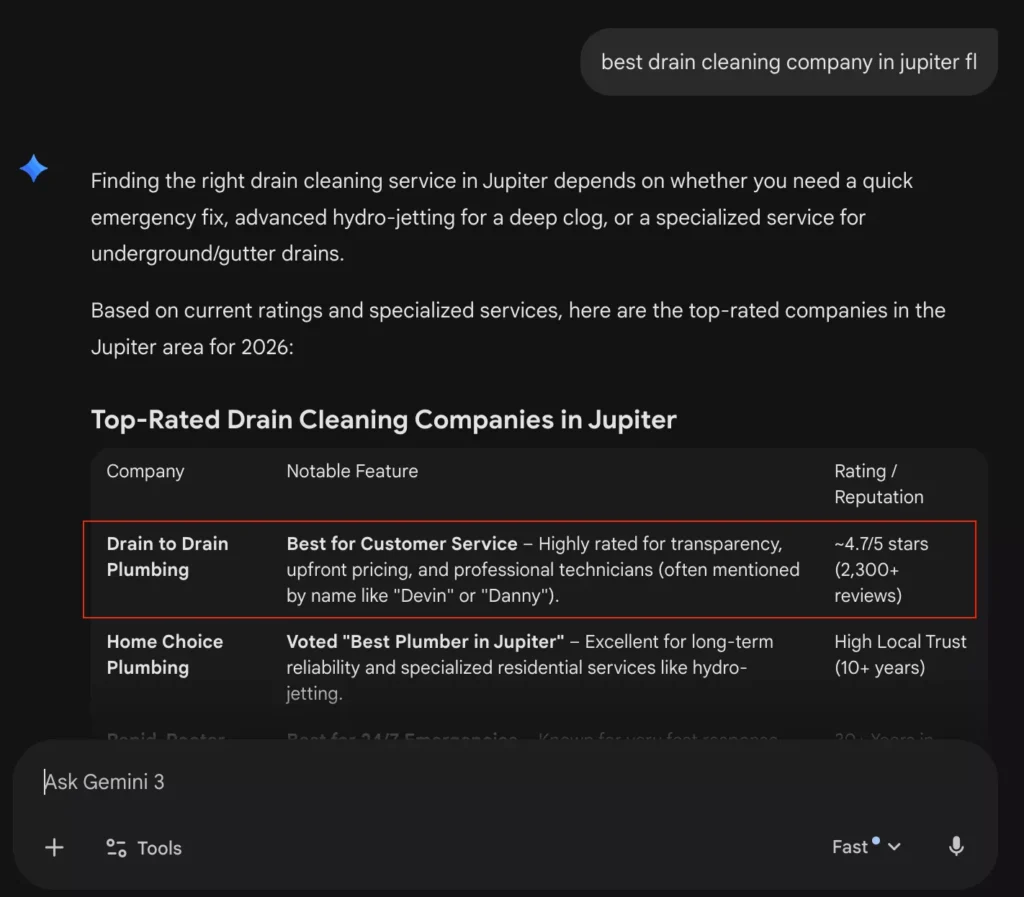
Google Gemini
Google Gemini powers both AI Overviews and AI Mode and also serves as a standalone platform that behaves similarly to ChatGPT.
Below you can see an example of a local plumbing conatractor appearin in a Gemini answer.
ChatGPT
With over 800 million weekly users, ChatGPT was the platform that placed AI at the forefront of evolving search behavior.
The example below features a local plumbing company that ChatGPT lists and directly cites.

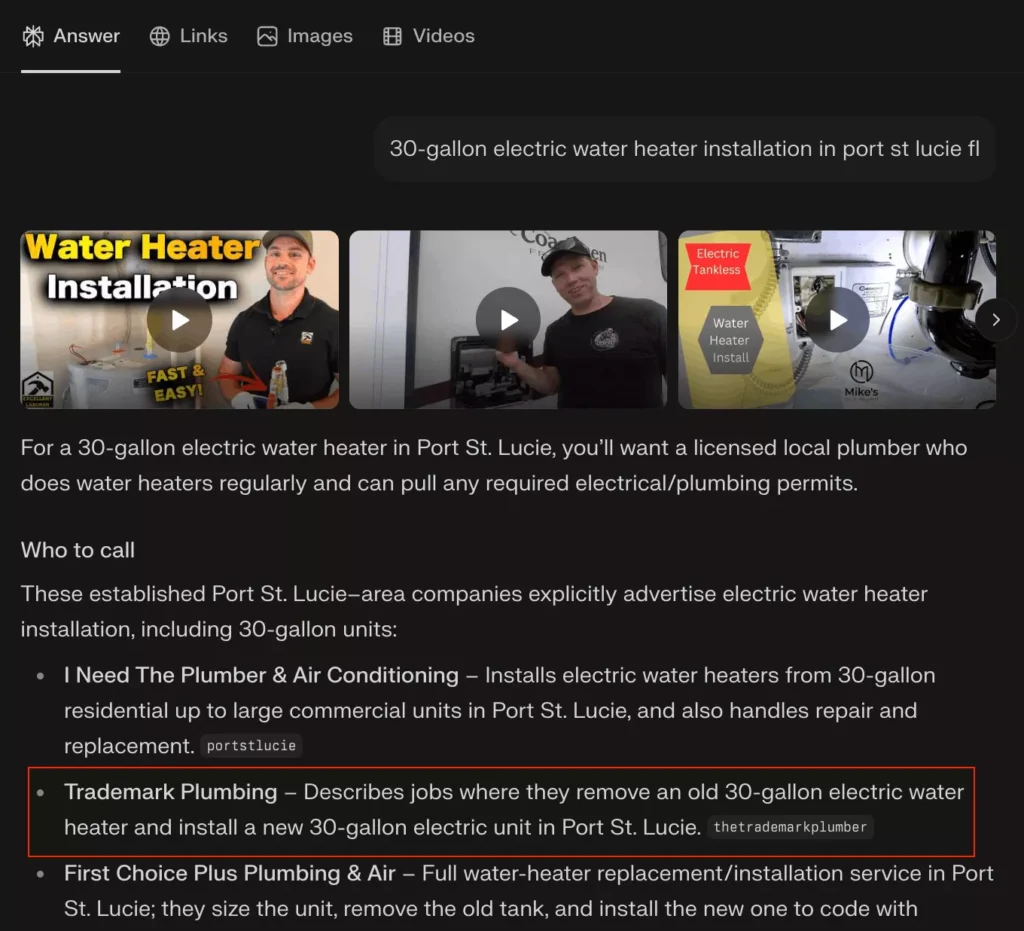
Perplexity
With over 30 million monthly active users, Perplexity represents an emerging trend of AI-powered search platforms that diversify users’ attention.
The example below highlights a local plumber appearing in a Perplexity-generated answer.
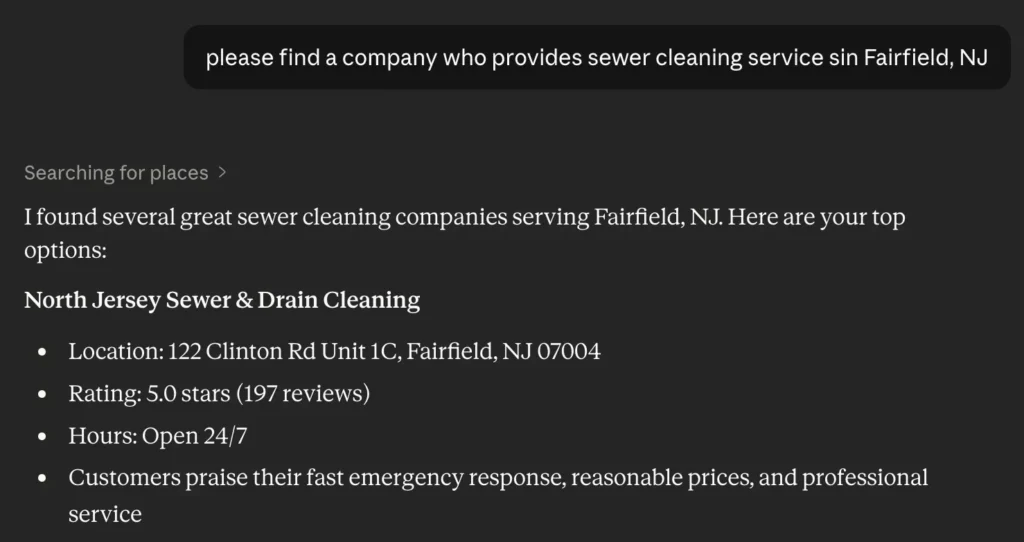
Claude
Anthropic’s Claude is better known for its reasoning-first architecture than for its live web browsing (though it can do both). While less likely to be used to find a plumber, its presence in the answers is evidence of sound AEO.
Below is a screenshot of a local plumbing company appearing in a Claude answer.
Final Thoughts on AI SEO for Plumbing Companies
AI SEO, or AEO, is the process of making your plumbing company the most retrievable, trustworthy, and consistent entity within the AI SEO ecosystem, which includes Gemini, ChatGPT, Perplexity, and Claude.
This guide outlines AI SEO’s fundamental components, such as query fan-outs, content chunking, vector embeddings, and consensus checking.
As search behavior evolves, so too should your plumbing company’s approach to web visibility and to expanding your mindset from “website optimization” to becoming a knowledge entity and a digital brand.
By implementing these processes into your digital marketing campaign, you can maximize visibility through AI SEO for plumbers.