
Video marketing is one of the most effective ways to show plumbing customers what they want in a contractor: trust, reputation, and perceived expertise.
A homeowner comparing plumbers online can’t verify a company’s competence from a bullet-point list of services, but watching a contractor actually diagnose and fix a problem gives them something closer to a firsthand reference.
That’s part of the psychology behind video’s effectiveness for home service businesses: it gives a prospective customer some of the familiarity and confidence they would otherwise have to get from a referral, review, or previous experience with the company.
Getting discovered starts with two different systems working together. Plumbers need visibility in Google’s local search results. Beyond that, a presence on YouTube, Instagram, and Facebook extends reach to buyers who are researching visually rather than searching directly.
Key Takeaways
- Video builds trust with prospective customers before they ever call, because footage of real jobs and real staff gives buyers the visual proof that text and photos can’t.
- YouTube is the platform to prioritize: it’s the second most-visited website in the world after Google, ahead of Facebook and Instagram in overall traffic.
- Embedding YouTube video on your website supports SEO without consuming server space, though it comes with a real page-speed tradeoff worth weighing.
- Video marketing isn’t universally beneficial. It has real costs (time, equipment, on-camera comfort) and real risks (customer privacy, page speed) that determine whether it’s worth doing for your business right now.
- Solo operators and pre-revenue plumbers can still use video, but the approach looks different from what works for an established multi-technician company.

Recording Video Content
A smartphone is all plumbers need to get started. Most modern phones include video recording and basic editing tools built in, which keeps the initial cost extremely low.
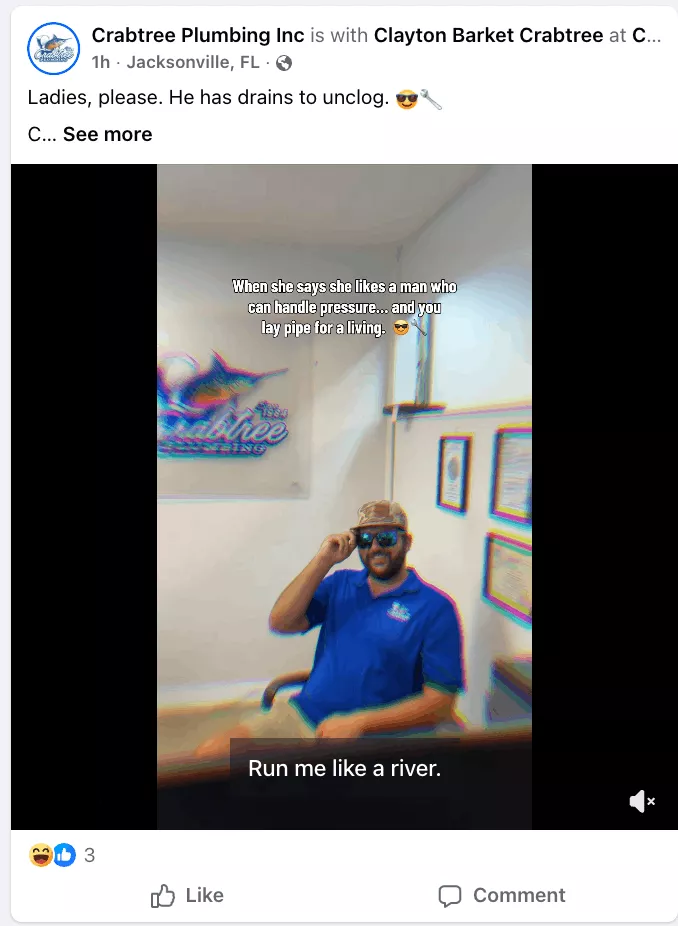
On-the-job Videos
Capture the strongest trust signal available: footage of a plumber actually working. When prospective customers see a team in action, they develop confidence in that team’s competence before ever making contact.
Any footage that could reveal a client’s personal information, address, or account details should be edited out or avoided at the recording stage, both to protect the client and to reduce the privacy and potential legal risks of publishing identifiable details about someone’s home without consent.

Equipment Videos
Highlight the tools a plumbing company uses on the job. Recording a walkthrough of new equipment, or even a short comparison between two tools, gives viewers a sense of the company’s investment in doing the work properly.

Staff Videos
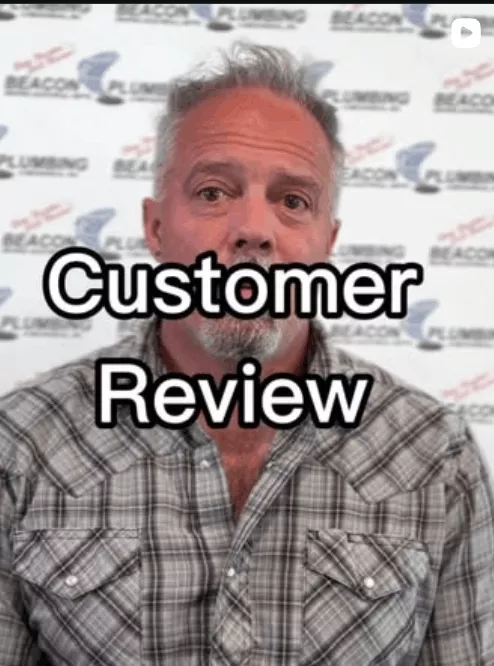
Put names and faces to the business. Every team member, from the person answering the phone to the newest contractor, contributes to the sense that a real company with real people stands behind the work.
A solo operator without a team to feature can adapt this format around themselves: a short clip introducing who does the work and why still delivers the same trust signal.
From Recording to Publishing (Workflow)
Turning raw footage into a published video follows the same sequence regardless of which platform it ends up on:
- Trim the footage. Cut unnecessary or low-quality sections; most editing tools include transition features so cuts between clips look intentional rather than abrupt.
- Add branding. Overlay a logo, typically positioned in a bottom corner, and consider a short intro or end screen with the company name, address, and phone number.
- Export the file. Save the finished video as an MP4, the format most platforms, including YouTube and Facebook, accept for upload.
- Name the file for search. Use a recognizable filename such as water-heater-repair-dallas.mp4 rather than a generic camera-generated filename. This makes the company’s video library easier to manage, but the video’s title, description, thumbnail, and content are more important for discovery.
- Upload to the intended platform. The same exported file typically works across YouTube, Facebook, and a website’s video embed.
Choosing Editing Software
Five tools cover most plumbing companies’ needs, and they differ enough on platform and cost that picking one comes down to what device the team already uses:
| Software | Platforms | Cost | Skill level |
|---|---|---|---|
| iMovie | iPhone, Mac | Free | Beginner |
| CapCut | Windows, Mac, iOS, Android, and web | Free, with a paid Pro tier | Beginner |
| DaVinci Resolve | Windows, Mac, and Linux | Free, with a paid Studio tier | Intermediate to advanced |
| PowerDirector | Windows, Mac, Android, and iOS | Free version with paid tiers | Beginner to intermediate |
| Canva | Web-based, with mobile apps | Free version with paid tiers | Beginner |
For a team already working on iPhones and Macs, iMovie avoids adding a new platform to learn. CapCut is built around short-form video, which makes it the fastest option for clips headed to Instagram or Facebook.
Teams that want more editing control without paying for it get the most out of DaVinci Resolve, though it has a steeper learning curve than the other tools here.
Sharing Video Content
Once a video is exported, YouTube and a website’s video embed are the two most valuable places to share it, and both routes start with the same step: uploading the file to a YouTube channel.
YouTube
Creating a YouTube channel requires a Google Account. Once you create a YouTube channel, you can upload your videos. After uploading, YouTube prompts for a title, thumbnail, tags, and description.
Use a keyword-relevant title and an accurate, appealing thumbnail. Video descriptions allow up to 5,000 characters, and a unique, specific description for each video helps both search visibility and viewer context, though there’s no fixed ideal word count.
Front-loading the first sentence or two with the most important information matters more than hitting a specific length, since that’s the portion visible before a viewer clicks “show more.”
YouTube is the second most-visited website in the world after Google, ahead of Facebook, Instagram, and every other site tracked, as of 2026.
Its enormous audience, strong presence in Google Search, and growing visibility in AI-generated search results make YouTube the highest-priority video channel of the three covered here.

Website Embed
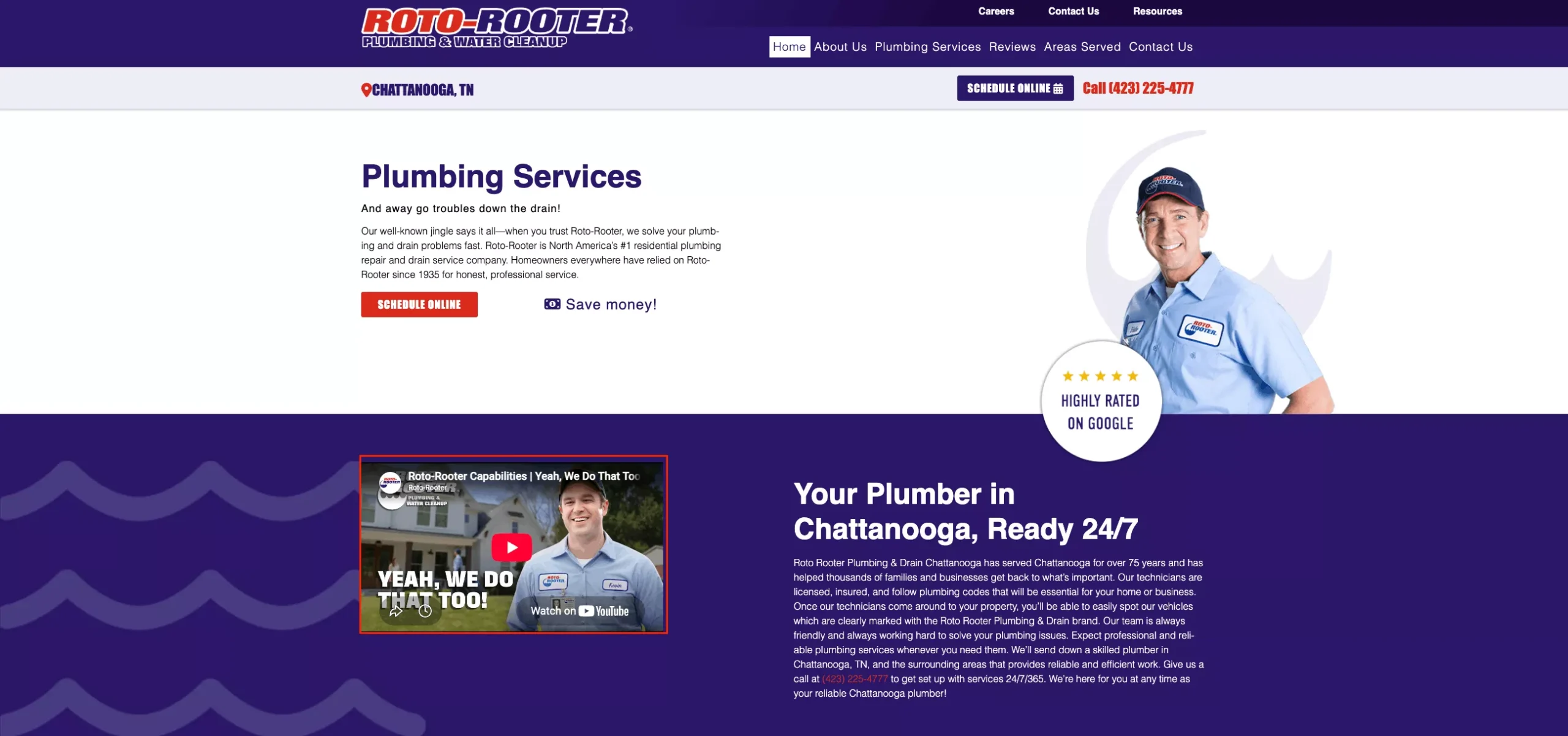
Embedding a YouTube video on a plumbing website, rather than uploading the video file directly to the site, keeps the video hosted on YouTube instead of the website’s own server.
Google can discover third-party videos embedded on webpages, but simply adding a YouTube embed to a service page or blog post does not automatically make that page a video result. Google reserves many video-search features for dedicated watch pages where viewing the video is the page’s primary purpose.
An embedded video can still improve the page for visitors, while the original YouTube watch page remains independently eligible to appear in Google’s video results.
Embedding isn’t free of tradeoffs. Loading a YouTube player introduces third-party resources that can affect page performance and may also need to be accounted for in the site’s cookie-consent setup.
For a site that already struggles with speed, an embed can measurably slow the page it’s meant to enhance, so it’s worth testing the actual page-speed impact before adding embeds across every page on the site.

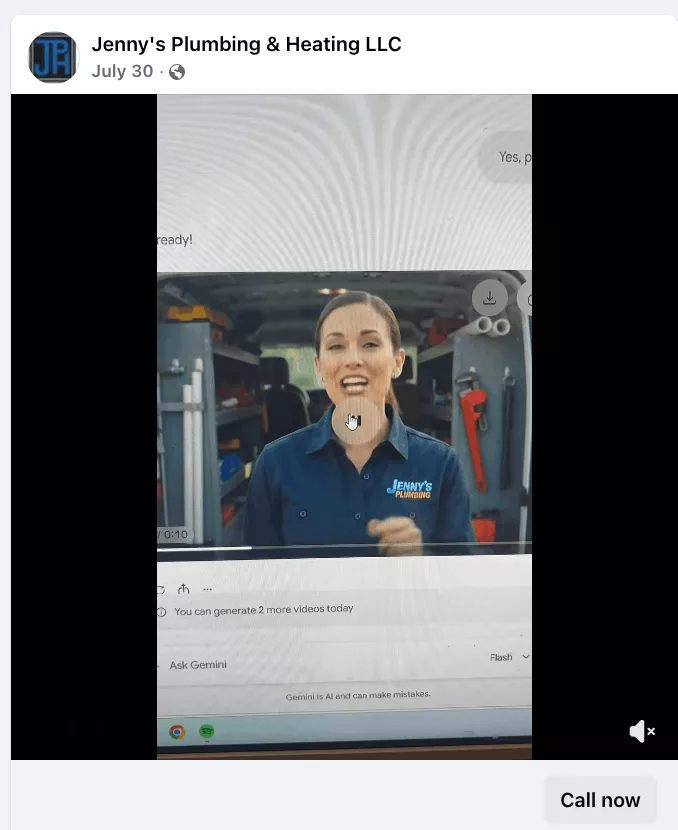
Organic reach for Facebook business pages is limited, which makes Facebook a secondary distribution channel for most plumbing companies rather than their primary video host
Publishing the video natively to Facebook keeps the file hosted on Facebook’s own servers instead of the company website, and video content on a Facebook business page still helps prospects who check the page before contacting a company.
Instagram offers two primary short-video formats: Stories and Reels. Instagram has changed its format length limits multiple times since Reels launched in 2020, so a specific second count quickly goes stale.
Both formats are still built around short-form content rather than long-form uploads, so treating Instagram as a place to post shorter cuts or highlights of longer videos, rather than a primary hosting destination, fits how the platform is used.
YouTube vs. Instagram vs. Facebook
| YouTube | |||
|---|---|---|---|
| Best use case | Primary video host, how-to content and search discovery | Short visual clips, Reels and local brand visibility | Secondary distribution and existing audience |
| SEO value | High; videos can rank prominently in Google and YouTube | Moderate; eligible public posts and Reels can appear in Google Search | Lower; primarily a social-distribution channel |
| Cost of entry | Free hosting; embeds can affect page performance | Free | Free; organic business-page reach can be limited |
| Format fit | Long-form, Shorts and searchable evergreen video | Primarily visual, short-form/social content | Native video/Reels across multiple lengths |
Benefits of Video Marketing for Plumbers
Video marketing supports plumbing companies primarily through two mechanisms: search visibility and conversion. Video can earn organic visibility when it matches search intent and gives search engines enough context to understand, index, and surface it.
SEO
YouTube videos can rank directly in Google Search, while webpages built specifically around a video can also become eligible for Google’s video features when they meet Google’s video-indexing requirements.
Because Google owns YouTube, YouTube has substantial visibility within Google Search, so plumbing companies can treat their YouTube channel as an extension of their broader SEO strategy rather than an isolated social-media account.

AI Search Visibility
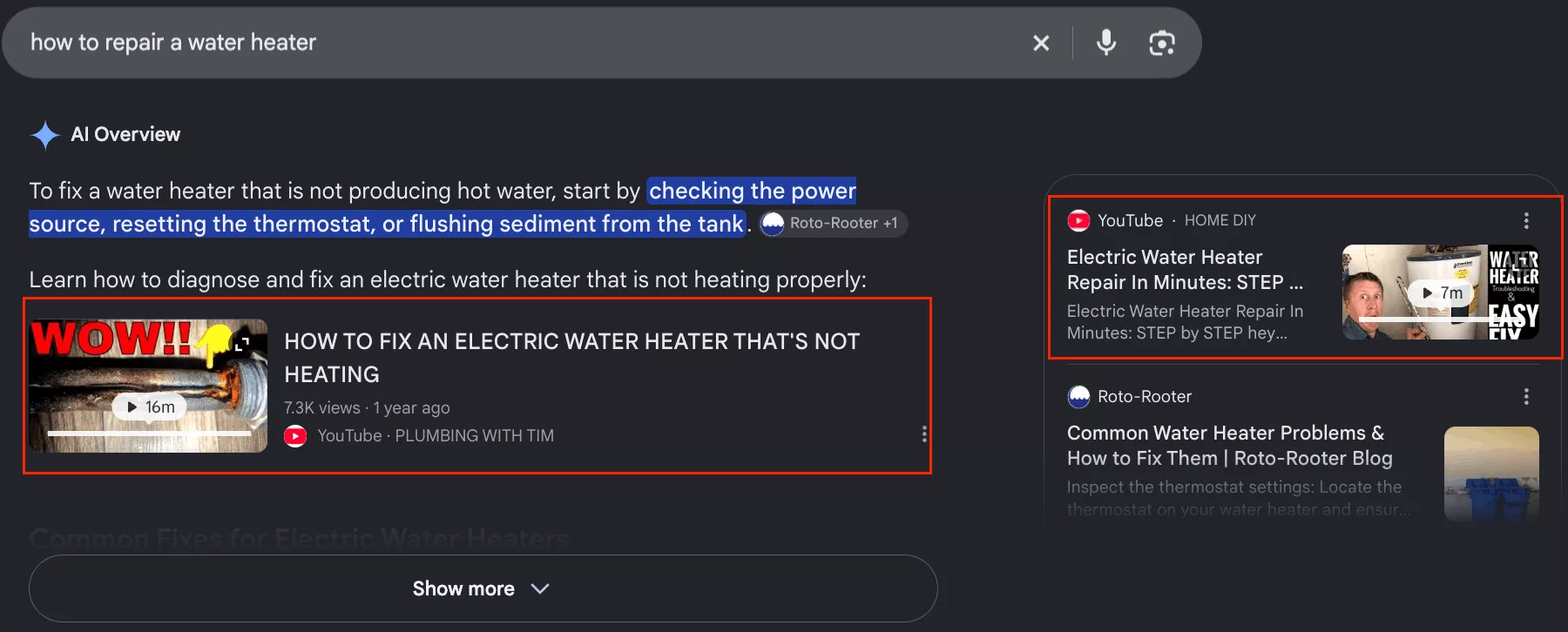
YouTube is now cited in AI-generated search answers far more often than any other video platform, which makes it relevant to search visibility beyond traditional rankings.
BrightEdge citation-tracking data reported by Search Engine Land found YouTube cited roughly 200 times more often than any other video platform across AI search engines, with a 29.5% citation share in Google AI Overviews, the top domain there.
Google AI Mode shows the same pattern, citing YouTube as its top domain at a 16.6% share. Perplexity and ChatGPT cite YouTube less often than Google’s own AI surfaces do, though citation share on both is growing.
The videos most likely to earn these citations are instructional, how-to content with descriptive titles and descriptions, the same elements already worth getting right for standard YouTube SEO.
For a plumbing company, that overlap means a well-made how-to video isn’t just competing for search rankings and social reach. It’s also positioned to be the source an AI assistant pulls from when someone asks how to handle a plumbing problem.
Conversions
Video on a landing page or service page can support conversions by giving a hesitant buyer more information before they decide to call or book an appointment, similar to a detailed service description or a set of before-and-after photos.
Trust and familiarity help move someone from browsing to calling, and video is one of the most effective formats for building both, though the lift varies by business and video quality and isn’t something a single blanket percentage can capture.
When Video Marketing Doesn’t Move the Needle
Video marketing isn’t a universal fit, and knowing when to skip it or scale it back saves time better spent elsewhere.
- When there’s no time to produce useful video. A channel with only occasional uploads can still provide value, but video becomes harder to justify when shooting, editing, and publishing consistently takes time away from higher-priority work. Quality and usefulness matter more than maintaining an arbitrary posting schedule.
- When customer privacy can’t be protected. In-home service work regularly puts a camera near a customer’s personal property, family, or private information. Posting footage from a job without the customer’s explicit consent creates real liability, separate from any marketing upside, and that risk applies even to seemingly harmless background details like mail, medication, or a visible home address.
- When page speed is already a problem. Embedding video, especially several embeds on one page, adds load time. For a site that already ranks poorly on page-speed metrics, adding several embeds without addressing the underlying speed issue can further degrade performance, so test the impact rather than assume it.
- When there’s no comfort with being on camera. Video built around staff and on-the-job footage assumes a level of comfort with being filmed that not every team has. Forcing reluctant staff on camera tends to produce content that undercuts the trust it’s meant to build, rather than reinforcing it.
Video Marketing for Solo and Budget-Limited Plumbers
A solo plumber or a company just starting out doesn’t need a video budget to participate in video marketing, but the approach looks different from what an established, multi-contractor company would do.
- Start with a smartphone and no production budget. The same on-the-job and equipment video formats described earlier work with a single phone and no editing software beyond what’s already built into the device.
- Film solo-friendly formats. A short clip narrated by the owner while working, rather than footage requiring a second person to hold the camera, removes the staffing constraint entirely.
- Post inconsistently rather than not at all. One video every few weeks, published whenever there’s time, still builds a channel history. It’s a lower bar than the constant-cadence approach that works for larger teams, and it’s still better than no video presence.
- Skip paid production until there’s revenue to support it. Hiring a videographer becomes worth considering once a business has steady work and wants to invest in a more polished look, but it isn’t a prerequisite for getting started.
Bottom Line
Plumbing companies that use video build trust with prospective customers through a channel that text and photos can’t fully replicate, and YouTube is the platform most worth prioritizing because of its search visibility and traffic.
The right approach depends on the business, though: an established company with staff and equipment has different options than a solo operator working with a smartphone and no budget, and both should tailor their video strategy to what they can realistically sustain rather than copy a one-size-fits-all playbook.

Author: Nolen Walker
Nolen Walker is the founder of Plumbing Webmasters and the creator of DataPins™, a Local SEO platform for plumbing companies. He has over 16 years of experience helping plumbing businesses grow through organic search, Google Maps, and AI-driven visibility.
Nolen is the author of A Complete SEO Guide for the Plumbing Small Business Owner. He also hosts The Plumbing SEO Podcast on Spotify.