
Branding for plumbers is the ongoing work of shaping how potential customers perceive your company through reputation, visibility, and the signals your business sends to the market.
Below are the specific tactics that build that perception, along with where each one fits depending on your plumbing company’s size, budget, and stage of growth.
Key Takeaways
- 97% of consumers read reviews before choosing a local business, as of BrightLocal’s February 2026 survey, making review management the foundation of plumbing brand reputation.
- 89% of consumers now expect a reply to their review, and 81% expect one within a week.
- Use of AI tools like ChatGPT for local business recommendations rose from 6% to 45% in a single year, and appearing in those answers depends on the same technical fundamentals that already govern standard search visibility.
- Google Business Profile and Yelp serve different roles for a plumbing brand, and prioritizing between them depends on a business’s existing review volume, rather than which platform is more popular overall.
- A strong brand persona can backfire when it narrows a plumbing company’s appeal more than it sharpens it, so align your persona choices to your local market before locking them in.
- Branding costs and timelines vary by tactic. Reputation management and brand-values positioning are typically inexpensive but time-consuming, while sponsorships and award badges typically require a budget that newer or smaller operations may not have yet.

What is Branding for Plumbers?
Branding for plumbers is the deliberate management of how potential customers and the public perceive a plumbing company. A well-developed brand signals trustworthiness, specialization, and reliability before a customer ever picks up the phone.
This is different from a logo or a slogan, though those still matter. The tactics below fall into three categories: reputation management (what other people say about the business), digital brand signals (what the business’s own web presence proves), and community and persona positioning (what makes the business memorable and locally relevant).

Managing Your Plumbing Brand’s Reputation
Online reputation is the most direct form of plumbing brand trust because 97% of consumers read reviews before choosing a local business, according to BrightLocal’s 2026 Local Consumer Review Survey. Building and maintaining that reputation comes down to three actions, in order:
- Get listed. Claim and complete listings on Google Business Profile, Yelp, Angi, and HomeAdvisor. Only 35% of small businesses currently have a claimed Google Business Profile, so completing this step alone is a meaningful differentiator, not a formality.
- Ask for reviews. Request feedback from every customer, both in person and through an automated follow-up such as a text or email sent after a job closes. Consistency matters more than any single request. A one-time push produces a burst of reviews that goes stale; an ongoing request habit keeps a review profile current.
- Respond to every review, positive and negative. 89% of consumers now expect a business to reply to their review, and 81% expect a response within a week, per the same 2026 BrightLocal survey. A negative review that gets a calm, specific, professional reply often builds more trust than a page of five-star reviews with no owner engagement, because it shows a prospective customer how the business handles a problem when one happens.
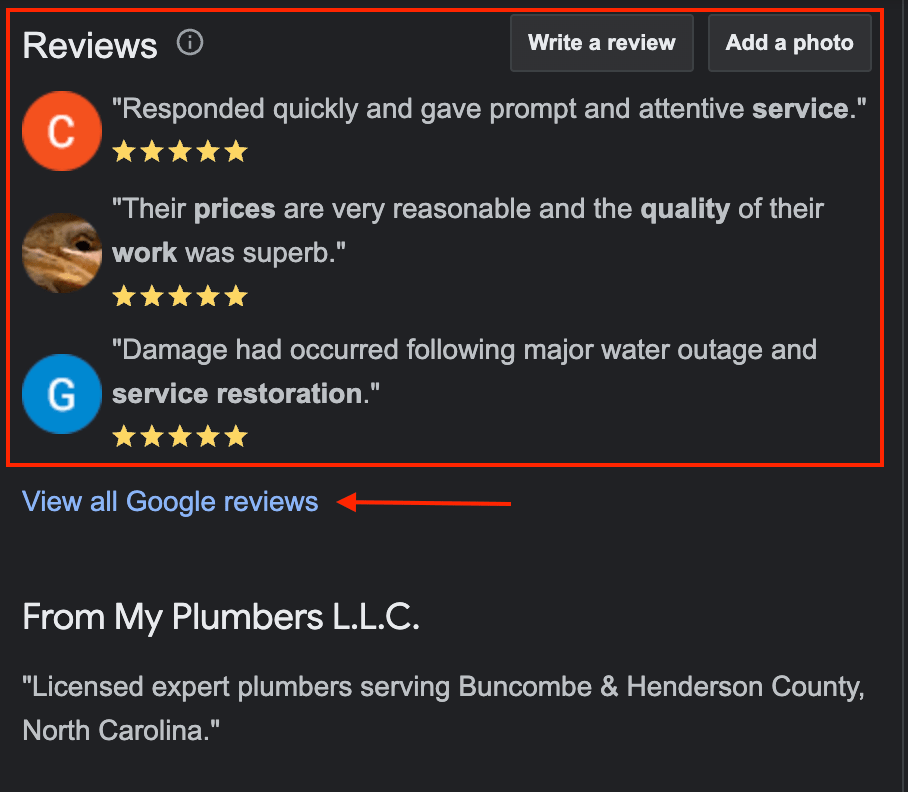
For a new business with no review history, the priority order flips slightly: getting the first 10 to 15 reviews matters more than perfecting the response process, since most prospects evaluate whether a business is established before they evaluate how it handles complaints.
Google Business Profile vs. Yelp for Plumbers
| Google Business Profile | Yelp | |
|---|---|---|
| Where reviews get written | Most-used platform for writing reviews, at 45% (BrightLocal, 2026) | Third most-used platform for writing reviews, at 24% |
| Visibility | Appears directly in Google Search and Google Maps results for branded and local searches | Appears in its own directory and within ChatGPT, along with third-party integrations, but has less direct overlap with Google Search results |
| Best fit | Any plumbing business, since it’s the highest-traffic option and free to claim | Most plumbing companies, as visibility on ChatGPT has become increasingly influential and Yelp remains a credible citation for local businesses |
Google Business Profile is the higher-priority platform for most plumbing companies given its review volume and direct search visibility. However, Yelp is still worth claiming and maintaining, especially considering its recent partnership with OpenAI.
Spreading review requests across multiple platforms is ideal. For example, a North Carolina plumbing company grew from roughly 700 reviews collected over seven years to more than 1,400 within about a year, after earning reviews across Google, Facebook, Yelp, the Better Business Bureau, and Angi.
Appearing in AI-Generated Answers
Appearing in AI-generated answers from tools like ChatGPT and Google’s AI Overviews depends on the same fundamentals that determine standard search visibility. Google’s own documentation states that a page must be indexed and eligible to appear in Search with a snippet to be eligible as a supporting link in AI Overviews or AI Mode, and that no additional or special optimization is required beyond that.
This matters more each year: use of AI tools for local business recommendations rose from 6% to 45% of consumers in a single year, making AI tools the third most-used recommendation source behind Google and Facebook, per BrightLocal’s 2026 survey.
Google’s AI features use a technique called query fan-out, issuing multiple related searches across subtopics to build a response, which means a plumbing company’s content needs to answer specific, narrow questions clearly (what a service costs, what area it covers, what a typical job involves) rather than relying on broad, generic pages.
Practically, the same work that supports standard search rankings, accurate business listings, clear service pages, and a technically healthy website also supports AI-answer visibility.
Establishing Digital Brand Signals
A plumbing website’s digital brand signals prove a business operates where and how it claims, which separates a credible local business from a page built to rank without real-world activity.
Showcase Recent Plumbing Jobs
Documenting completed jobs in specific neighborhoods is one of the clearest ways to prove local operation. This typically involves publishing job photos, the neighborhood or city where the work happened, and structured data that marks the page up so search engines can parse those details.
Structured data is a standardized format that helps Google understand a page’s content and the entities it describes, such as the business, its service area, and the specific job documented.
When a job page includes real photos, a real location, and accurate markup, it functions as direct evidence rather than a general claim of experience.
Include Award Badges and Business Affiliates
A plumbing website should display award badges from credible institutions, such as PHAA (the Plumbing-Heating-Cooling Contractors Association’s affiliated recognitions), alongside links to trusted suppliers or manufacturer partners.
Most award bodies email an HTML badge that a developer can embed directly into a site’s header or footer. Linking to credible affiliates works the same way: it associates the business with organizations a customer already trusts.
Earn Branded Searches
Branded search volume, how often people search for a company’s name directly, is rated by SEO professionals as one of the stronger authority signals a business can build, though this is based on a 2026 survey of 131 SEO practitioners rather than an official Google confirmation, since Google has not publicly confirmed branded search volume as a direct ranking factor.
In practice, a customer who hears about a plumbing company through word of mouth or social media and then searches for that company by name generates exactly this kind of signal.
Diversifying promotion through social media and community engagement is one of the most reliable ways to grow branded search volume over time, since it creates more word-of-mouth moments that lead someone to search for a business by name.
Immersing Your Plumbing Brand in the Community
Community visibility works alongside reputation management but requires more direct, in-person involvement. A plumbing company that shows up consistently at local events, sponsorships, and organizations becomes recognizable in ways reviews alone can’t. Three approaches work well:
- Local sports teams. Sponsoring youth sports, through uniforms, equipment, or event support, puts a plumbing company’s name in front of the families who need its services and creates natural word-of-mouth. Sponsorship dollars don’t guarantee leads on their own; the return depends on visibility (logo placement, mentions at events) rather than the sponsorship itself.
- Local charities. Donating to or partnering with charities a community already supports builds goodwill and ties the business to causes local customers care about.
- Local activity. Serving on a PTA, school board, or chamber of commerce, or participating in local leisure activities, puts a plumbing company’s owner or team directly in front of community members. This costs time rather than money, which makes it one of the more accessible options for a newer or budget-limited business.
Crafting a Brand Persona
A brand persona works by highlighting a genuine commonality between a plumbing company and its local market rather than inventing a personality that doesn’t fit the business. Three examples illustrate different approaches:
- The Metro Plumber. A business operating in a dense metro area can build a name, logo, or slogan around fast, premium service suited to a hectic urban market.
- The Religious Plumber. Some plumbing companies build their customer base around shared faith, incorporating a religious symbol, verse, or reference into their branding.
- The Sports Plumber. In regions with strong local sports culture, using team colors or sports references in branding can create an immediate, recognizable connection.
A persona-driven brand carries real risk if it’s over-niched: a religious or sports-team-affiliated brand can alienate customers outside that identity group, and a persona chosen because it’s trendy rather than genuinely reflective of the owner or the local market often reads as inauthentic.
These personas also assume a dense population center or a strong local identity to latch onto; a plumbing company serving a smaller or more rural service area may get more traction from a persona built around personal reliability or multi-generational local roots than from a big-city or team-affiliated angle.
Establishing Brand Values
A plumbing brand can also be built entirely on what the business does well, independent of persona or reputation tactics, making this one of the lowest-cost branding paths for a newer or budget-constrained operation. Three common value angles:
- Responsiveness. A business that highlights fast response times in its branding becomes the plumber customers call first for an urgent issue.
- Luxury. A business specializing in cosmetic or high-end plumbing work can brand around transforming kitchens and bathrooms, using fonts, colors, and naming that signal quality.
- Versatility. A business handling both commercial and residential work can brand around range and flexibility, with a slogan that makes that breadth memorable.
Final Thoughts on Plumbing Branding Strategies
Plumbing brand building compounds over time rather than happening in a single push. Reputation tactics like review requests and responses show measurable results within weeks. Digital brand signals and community involvement typically take months of consistent effort before they show up clearly in how customers describe or refer the business.
Persona-and values-based branding works more gradually, since it depends on repeated exposure to sink in.
The tactics that cost the least- reputation management, community activity, and values-based positioning- are also the most accessible starting point for a newer or smaller plumbing company.
Sponsorships, award badges, and paid digital signal tools are worth adding once budget allows, but they’re additive to the foundation rather than a substitute for it.
A plumbing brand built on consistent, documented, locally rooted proof of good work holds up regardless of which platform, search engine, or AI tool a customer uses to find a plumber.

Author: Nolen Walker
Nolen Walker is the founder of Plumbing Webmasters and the creator of DataPins™, a Local SEO platform for plumbing companies. He has over 16 years of experience helping plumbing businesses grow through organic search, Google Maps, and AI-driven visibility.
Nolen is the author of A Complete SEO Guide for the Plumbing Small Business Owner. He also hosts The Plumbing SEO Podcast on Spotify.