
Competitor analysis is one of the fastest ways for a plumbing company to find overlooked marketing opportunities in keywords, links, and conversions.
Focusing only on your own website’s keywords, content, and backlinks causes tunnel vision. Without a comparison point, you lose objectivity about how your site actually stacks up.
The most successful plumbing companies study their direct competitors as part of their SEO strategy.
Studying a competitor’s approach shows where your own keyword coverage and site authority still have gaps, even when you already rank well for your target terms. Additionally, ranking well today doesn’t protect you from new local competitors moving into those same positions.
Key Takeaways
- Competitor analysis compares your keyword rankings, backlinks, traffic, and site experience against your top three to six local competitors to find gaps you can close.
- Backlink authority matters far more for local organic rankings than for Google’s Map 3-Pack, where Google Business Profile signals like category and proximity carry more weight.
- SEMrush, Ahrefs, and Moz are the three tools most often named in this guide, but Google Search Console offers free, first-party data that covers keyword and traffic research for solo operators on a budget.
- Domain Authority, Domain Rating, and Authority Score are third-party metrics designed to approximate aspects of a website’s authority or ranking strength, but they use different inputs and formulas.
- Copying a competitor’s content word-for-word carries real risk under Google’s spam policies.
- Re-run a full competitor analysis after a Google core update, when a new competitor enters your Map 3-Pack, or when your rankings shift unexpectedly, since no fixed schedule fits every market.
Identifying Your Competitors
Start by choosing the top three to six plumbing websites targeting your general service area.
Using a keyword research tool such as SEMrush, Ahrefs, or Moz, search your primary keyword, formatted as “plumber [city, state],” and record the top three positions in Google’s Map 3-Pack, the traditional organic results, and the websites cited or linked within the AI Overview separately. Some companies appear in all three areas. Others appear in only one.
Comparing your keyword rankings to theirs shows who ranks higher for specific terms and which terms they rank for that you don’t.
This comparison is called keyword gap analysis: it identifies keywords your competitors rank for that your site does not, which is a subtopic of competitor analysis rather than a separate discipline.
A plumbing company ranking #1 for “plumber” may also rank for narrower terms like “slab leak repair,” “hydrojetting,” or “burst pipe repair,” each representing a keyword gap worth closing.
If your market has few or no visible online competitors, standard competitor analysis has less to work with. In that scenario, broaden your comparison set to the nearest larger market or a well-optimized plumbing site in a different region, and treat your own historical rankings as the baseline to beat instead.
A thin competitive field is also often the fastest market to establish Map 3-Pack visibility in, since fewer businesses are actively optimizing their Google Business Profiles.
Comparing the Tools: SEMrush, Ahrefs, and Moz
Each of these three platforms performs keyword research and competitor analysis, but they differ enough in focus and pricing that naming them together without distinction isn’t useful for choosing one.
| Tool | Known Strength | Entry-Level Pricing Tier |
|---|---|---|
| SEMrush | Broadest all-in-one marketing toolkit, including PPC and social data alongside SEO | Paid, multiple tiers |
| Ahrefs | Backlink database depth and Domain Rating tracking | Free tier (for own website only); paid tier, multiple tiers |
| Moz | Beginner-friendly interface and Domain Authority as an entry point into link analysis | Paid, multiple tiers, plus limited free tools |
For a solo or one-truck operator on a limited budget, all three tools have a monthly cost. Google Search Console is a free service offered by Google that shows which search queries already bring traffic to your site, how often your site appears in Google Search, and how many searchers click through, using first-party data pulled directly from Google’s own index rather than a third-party estimate.
It won’t show a competitor’s keywords or backlinks the way a paid tool will, but it’s enough to start identifying your own keyword gaps and traffic patterns before investing in a paid platform.
What to Check During Competitor Analysis
Once you’ve identified your competitors and chosen a research tool, work through these eight categories:
- Missing keywords: terms your competitors rank for that you don’t
- Backlink profile: which domains link to your competitors, and how your link authority compares
- Estimated traffic: which of their pages get the most estimated traffic
- Consumer opinion: direct feedback from your own customers and site visitors
- Long-tail discrepancies: narrower search terms your competitors may be missing
- Content quality: how your written and video content compares to theirs
- Navigability: how easy their site is to use compared to yours
- Google Business Profile strength: how complete and active their Map 3-Pack listing is
Missing Keywords
Most research tools show your competitor’s ranking keywords and let you compare them to your own. The comparison reveals keyword gaps you’ve missed and can inform what new pages or content your site needs.

Backlink Profile
Inbound link quality and quantity to your domain rank among the top five ranking factors for local organic results, according to Whitespark’s 2026 Local Search Ranking Factors survey of 47 local search experts.
The same survey ranks those same link signals far lower for Google’s Map 3-Pack results, where Google Business Profile signals like primary category, business-title keywords, and proximity to the searcher carry substantially more weight. In practice, this means link building pays off more for your general organic rankings than for your Map 3-Pack position.
Comparing your website’s link metrics to your competitors’ can also identify which domains link to them. You may find relevant local sources, such as plumbing suppliers or chambers of commerce, that would be willing to link to your site as well.
Three different paid tools each publish their own estimate of a site’s backlink-driven authority, and it’s worth understanding how they differ before comparing scores across tools:
| Metric | Publisher | Scale | Basis |
|---|---|---|---|
| Domain Authority (DA) | Moz’s own definition of Domain Authority | 1 to 100, logarithmic | Predicts ranking likelihood based mainly on backlink profile |
| Domain Rating (DR) | Ahref’s Domain Rating metric | 0 to 100, logarithmic | Backlink profile strength relative to other sites in Ahrefs’ index |
| Authority Score | SEMrush’s Authority Score metric | 0 to 100 | Compound score combining link power, organic traffic, and spam signals |
None of these three metrics is a Google ranking factor. Moz states this directly on its own Domain Authority page, and each company calculates its score using a different, proprietary method, which means the same website can show meaningfully different numbers across all three tools.
Use any one of them consistently to track your own progress over time or to benchmark against direct competitors, rather than treating the number itself as a target Google rewards.
Page Traffic
Examining which pages on a competitor’s site are most popular is useful, since these pages often accumulate the most backlinks.
Some popular pages rank for more than one keyword, which signals that the page satisfies a broader user intent, such as “plumbing services” generally rather than one narrow service. Comparing these pages to your own can reveal subtopics you’ve overlooked.
Consumer Opinion
Asking your customers and site visitors for direct feedback is a source of competitor-analysis-relevant data that no third-party tool can provide.
If you have an email subscriber list, send a short questionnaire about your website’s user experience. Useful questions to include:
- Did you find what you were looking for on our site within the first minute?
- Was it clear how to request a quote or book a service?
- Did anything on the site feel confusing, slow, or out of date?
- How did our site compare to other plumbing companies you looked at?
- Would you recommend our website to a friend searching for a plumber?
Long-Tail Discrepancies
Even a competitor with few visible weaknesses on primary terms like “plumber” or “plumbing company” is likely to have gaps in the long-tail searches that drive smaller volumes of traffic on the margins. Standard keyword research tools won’t surface every long-tail variation.
This is where understanding your services, customers, and consulting with a person or agency with digital marketing experience provides nuance that can separate you from competitors.
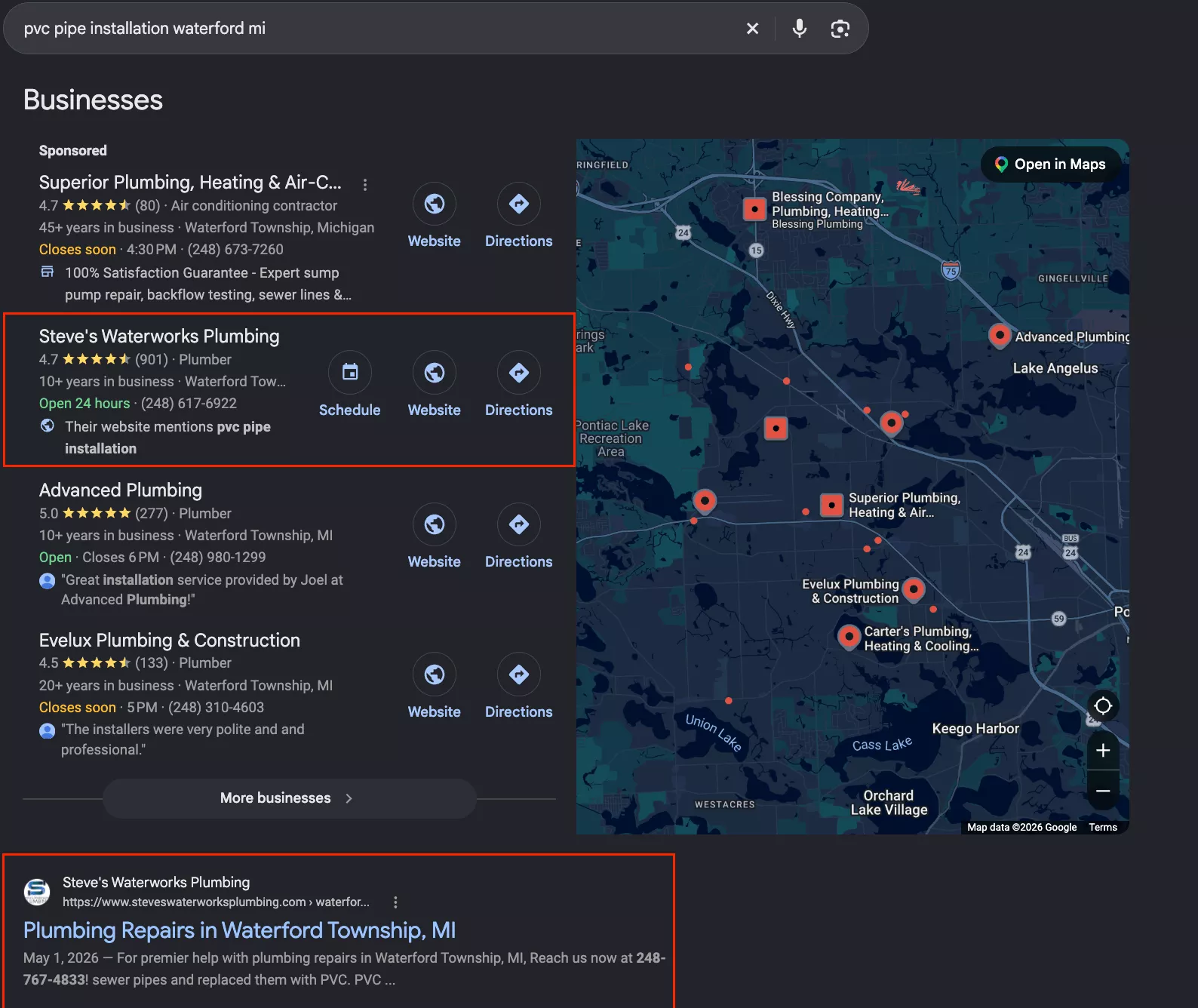
For example, one Michigan plumbing campaign increased website traffic by 122.2% in 30 days while gaining visibility for specialized long-tail searches such as pvc pipe installation waterford mi.
Content Quality
Comparing your competitors’ written and video content to your own is worth the time, since Google’s ranking systems use multiple signals designed to surface helpful, reliable, and original content, making content quality an important part of organic search performance.
Google’s spam policies name “scaled content abuse” as a specific, enforceable policy: publishing large volumes of unoriginal content primarily to manipulate rankings, rather than to help users, can trigger a ranking drop or removal from search results, whether the content is automated, human-written, or both.
This is a more precise standard than a general “low-quality content” penalty; it focuses on intent and manipulation at scale, which has become more common because AI tools like ChatGPT, Claude, and Gemini can generate content quickly and easily.
Mass-producing low-quality blog posts can weaken signals across your entire site, which can affect your service pages and homepage as well as the posts themselves.
Studying a competitor’s content is not the same as copying it. Drawing on their topics, structure, or the questions they answer is standard competitive research. Reproducing their actual text closely or prompting an AI assistant to simply rewrite their page is a different matter:
Google’s spam policies specifically identify copying content from other sites, modifying it only slightly, and republishing it without adding original value as a form of abusive scraping when done to manipulate search rankings.
Navigability
Technical issues can hamper rankings, so studying a competitor’s user experience provides useful insight alongside their keyword and content data.
Navigate a competitor’s site as a potential customer would: check for dead links, confirm the site is easy to move through, and check whether every page links to another. Then run the same check on your own site using the same three questions.
Fixing what you find in your own review is where the quick wins in user experience and conversion rate actually come from.
Google Business Profile in Map 3-Pack Research
A competitor’s Google Business Profile deserves its own research step, separate from their website. Local ranking is based primarily on relevance, distance, and prominence, according to Google’s own Business Profile help documentation.
Relevance is how well a profile matches a search; distance is how close the business is to the searcher; prominence reflects how well-known the business is, based partly on links, mentions, and directories, and partly on review count and review score.
Reviewing a competitor’s Google Business Profile means checking their primary and additional categories, how complete their profile fields are, their review count and recency, and whether their business hours are accurate and current, since the same Whitespark survey found business hours accuracy and profile completeness rank among the highest-impact Map 3-Pack factors.
A competitor with a thin website but a fully built-out, active Google Business Profile can still outrank a site with stronger content and links, because Map 3-Pack ranking leans more heavily on profile signals than organic ranking does.
When Competitor Analysis Doesn’t Help, and How Often to Run It
Competitor analysis has real limits. Copying a competitor’s strategy outright, rather than using it as a starting point for your own approach, risks the scaled content abuse and duplicate content issues covered above, and it also means competing on their strengths instead of building your own.
A competitor’s rankings can also reflect a temporary spike, a recent core update, or a data anomaly rather than a durable strategy worth imitating, so treat any single snapshot of their site as a starting hypothesis rather than a conclusion.
No fixed interval fits every plumbing market, since no approved industry benchmark sets one. A practical trigger-based approach works better than a calendar: re-run your competitor analysis after a Google core update affects your rankings, when a new competitor appears in your Map 3-Pack, or when your own traffic or rankings shift in a way you can’t otherwise explain.
Monitoring competitor websites for new opportunities is part of ongoing digital marketing work and shouldn’t be approached as a one-time project. While original content built around your own expertise should always come first, comparing your site’s keywords, links, content, and Google Business Profile against your direct competitors on a recurring basis is what keeps that original content positioned to actually rank.

Author: Nolen Walker
Nolen Walker is the founder of Plumbing Webmasters and the creator of DataPins™, a Local SEO platform for plumbing companies. He has over 16 years of experience helping plumbing businesses grow through organic search, Google Maps, and AI-driven visibility.
Nolen is the author of A Complete SEO Guide for the Plumbing Small Business Owner. He also hosts The Plumbing SEO Podcast on Spotify.