
Plumbing PPC (pay-per-click advertising) involves displaying ads to local consumers across various platforms and paying a fee each time someone clicks an ad.
The cost per click (CPC) varies by the advertising platform, location, and search query (e.g., “plumber near me”).
Google Ads is the platform most commonly associated with PPC for plumbers.
As the founder of Plumbing Webmasters, I’ve managed pay-per-click campaigns for local plumbing contractors and tracked what actually moves the needle on cost per lead versus wasted spend. The guidance below reflects that work.
Key Takeaways
- Plumbing PPC is pay-per-click advertising: you pay each time someone clicks your ad, whether or not they become a customer.
- The average non-branded plumbing PPC lead cost $183 in early 2026, well above the $90.92 blended home-improvement average, because plumbing keywords are highly competitive.
- Google Local Services Ads are not PPC. They charge per valid lead (a call or message) instead of per click
- PPC delivers leads immediately; SEO takes months but produces a lower long-term cost per lead once it compounds.
- PPC works best paired with a defined budget, tight geographic targeting, and a landing page built for the specific service in the ad.
- It tends to underperform on very tight budgets, in saturated metro markets where the ad, keyword, and landing page aren’t tightly matched, and as a standalone strategy with no organic presence behind it.
Understanding Plumbing PPC
PPC ads run through an auction system that determines the cost per click and which ads show, and in what order.
Most plumbing accounts now run on Smart Bidding, Google’s automated bidding, rather than manual keyword-by-keyword bids. You set a target, such as cost per lead, and Google sets each bid.
Manual CPC still exists, but Smart Bidding is the current default recommendation for most plumbing businesses without a dedicated PPC team.
What actually prices each auction, manual or automated, comes down to three signals:
- Expected CTR: Google’s estimate for the percentage of users who will click through your ad.
- Ad Relevance: How closely your ad matches the user’s search query, including its intent.
- Landing Page Experience: How useful and easy to use your landing page is for users who click through, including its relevance to the ad it connects to.
These three signals feed Ad Rank on every campaign type, including Performance Max and AI Max for Search, even where there’s no visible keyword-level score.
The 1-10 Quality Score in a standard Search campaign is Google’s own diagnostic readout of those signals, useful for spotting a weak ad group or landing page, but it isn’t itself an input Google uses to price the auction.
Fixing the underlying match between ad, keyword, and landing page is what moves cost per click.
PPC vs. SEO vs. Local Services Ads
These three channels solve different problems, and confusing them is the fastest way to waste a marketing budget.
PPC works faster than SEO and can deliver leads to plumbers immediately. Organic SEO can take months to yield results, but it produces a lower cost per lead once rankings take effect.
Local Services Ads (LSA) differ from both: you’re charged for each valid lead you receive, such as a phone call or message, rather than for every click regardless of outcome.
| Channel | Cost model | Speed to results | Trust signal |
|---|---|---|---|
| PPC (Google Ads) | Pay per click, whether or not it converts | Fast, live within a day | Lower. Users increasingly distinguish ads from organic results |
| SEO | No per-click cost, but requires ongoing content and technical investment | Slow, typically months to build authority | Higher. Organic placement reads as earned rather than purchased |
| Local Services Ads | Pay per valid lead only | Fast, live once Google verifies your business | High. Carries a Google Guaranteed or Screened badge |
A plumbing company that needs the phone to ring this week has a real case for PPC or LSA. A plumbing company building a durable, lower-cost lead pipeline over the next year has a real case for SEO. Most established plumbing businesses run some combination of all three rather than picking one exclusively.
PPC Ad Types for Plumbing Companies
Search Ads
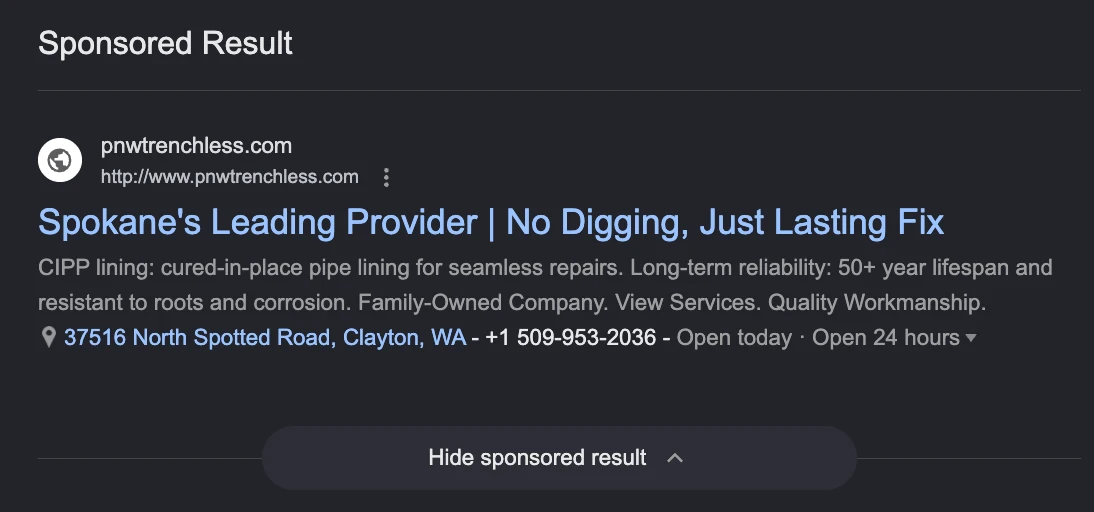
Search ads are the most common PPC ads for plumbers, appearing at the top of standard search engine results pages.
Google, Bing, and other search engines offer this ad type, and Google’s Search Network can also expand placements to partner sites and search results pages beyond Google.com.
These text-based ads mimic an organic SEO result but appear at the top of the SERP, above traditional results.
Social Media Ads
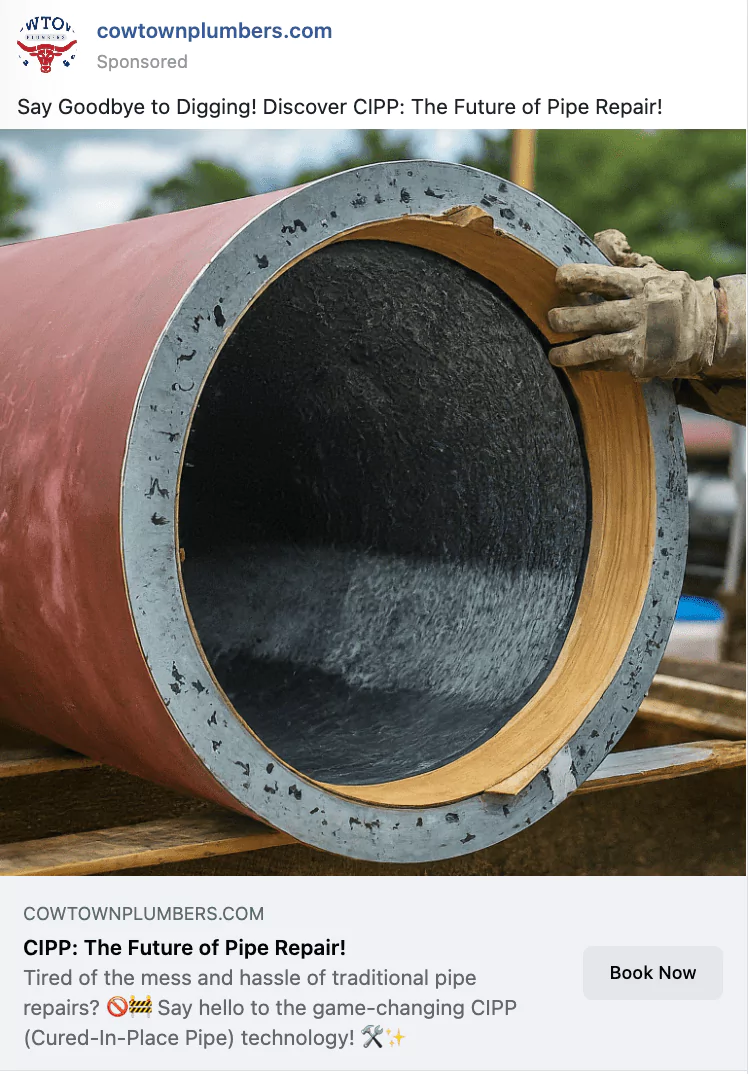
Social media ads appear on platforms like Facebook, Instagram, TikTok, X, YouTube, and LinkedIn. Each platform offers multiple ad variations, so plumbers can reach consumers in various areas of the app.
The Meta advertising platform, which handles Instagram and Facebook Ads, uses AI-powered targeting to help plumbing companies reach local customers. Social media ads can also be retargeted using the Meta Pixel.
| Google Ads (Search) | Meta Ads (Facebook/Instagram) | |
|---|---|---|
| Targeting basis | Active search intent (keyword-driven) | Interest, behavior, and audience demographics |
| Best for | Homeowners actively searching for a service right now | Building brand awareness and retargeting past site visitors |
| Typical use case | Emergency and same-day service calls | Seasonal promotions, maintenance plans, before/after visual campaigns |
Display Ads
Display ads appear across a display network of Google properties such as Google Search, Gmail, and YouTube. Advertisers can also run display ads on other networks, including Meta Audience Network, Yahoo Advertising, Taboola, and AdMaven.
Like social media ads, display ads can retarget previous website visitors or those who’ve engaged with your social media content.
Ad Budget Types
| Budget type | What it charges for | Best used for |
|---|---|---|
| CPM (Cost Per 1,000 Impressions) | A flat rate per 1,000 ad views | General brand awareness |
| VCPM (Viewable Cost Per 1,000 Impressions) | A flat rate per 1,000 verified views | Awareness campaigns where actual visibility matters |
| CPC (Cost Per Click) | Each click on the ad | Driving traffic and leads; the most common model for plumbers |
| CPV (Cost Per View) | Each time video content is viewed | Increasing video views and site traffic |
| CPA (Cost Per Acquisition) | Only completed goal actions (a form fill, a call) | Increasing sales and appointment bookings |
PPC Ads Examples for Plumbers
Google Search ads are shown to users based on their relevance to the query, along with Ad Rank and bid amount.
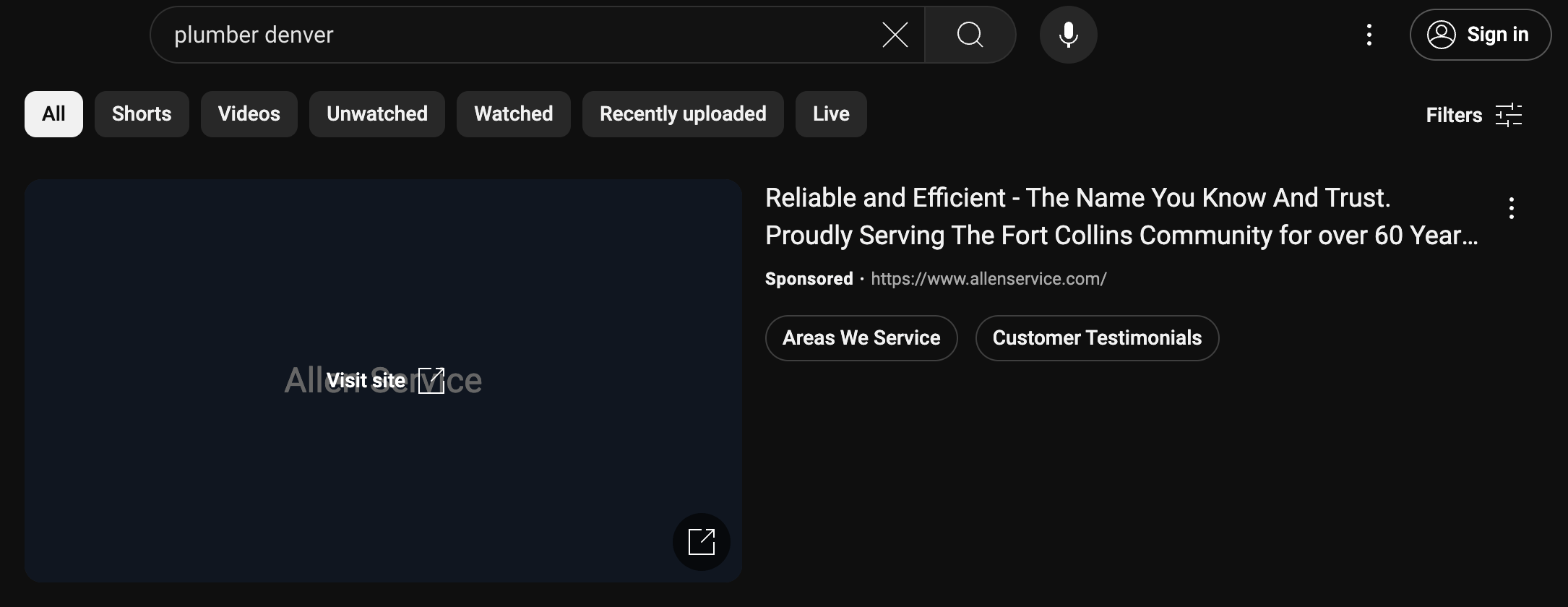
YouTube ads work similarly but appear on the YouTube platform, which plumbing companies can manage under the same Google account.
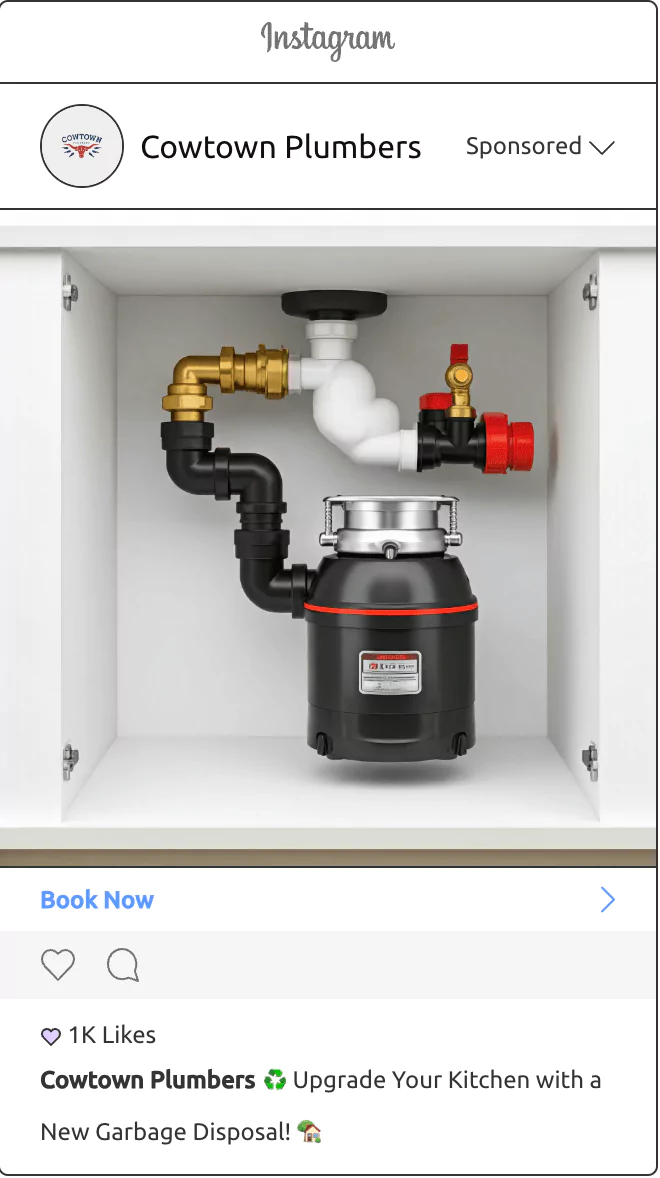
Facebook’s Advantage+ targeting helps maximize reach while reducing ad spend, and Instagram image ads perform best with high-quality visuals sized to the platform’s 1080×1080 resolution parameters.
Benefits of PPC for Plumbers
Quick Results. PPC ads deliver results quickly. Organic campaigns like SEO can take months to deliver tangible results, which frustrates plumbers whose mindset reflects a contractor rather than a marketing department.
Targeted Clicks. PPC allows advertisers to target clicks from specific locations, reducing wasted ad spend. Since plumbing companies serve customers locally, promoting services only within a defined service area benefits both the advertiser and the platform.
Performance Feedback. Most PPC platforms report campaign results clearly, reveal underperformance quickly, and provide data that can inform other parts of a digital marketing campaign.
Budget Control. PPC platforms let advertisers set a defined budget, which keeps small businesses like plumbing companies from accidentally overspending.
When PPC Doesn’t Work for Plumbers
PPC’s reputation is mixed throughout the plumbing industry, largely because campaign quality is inconsistent. Four conditions in particular tend to produce poor results.
Lack of Organic Support
Consumer Trust erodes when PPC runs without organic support. PPC ads are meant to emulate organic search results, but users have grown more ad-aware over time, and fewer trust an ad placement more than an organic result.
A homeowner may assume that if a plumber has to pay for the placement, the business isn’t well known. This effect is partially mitigated when the same business also ranks in the top organic positions, including Google’s Map 3-Pack and AI Overviews.
Agency Service Bundling
Agency Manipulation is a risk with bundled, non-transparent billing. PPC campaigns are easy for marketers to manipulate through tactics like black-box billing, which hides how marketing dollars are actually distributed.
Agencies often bundle PPC with ad spend, management fees, SEO, and website design (frequently glorified hosting), then blame underperformance on the business owner to justify more spend, rather than building a sustainable organic foundation alongside it.
Limited Budgets
At an average non-branded plumbing lead cost of $183, based on Q1 2026 data across 524 plumbing contractors, a daily budget under roughly $20 to $30 struggles to generate the click volume the auction system needs to optimize.
Small-budget plumbers often get better ROI by starting with Local Services Ads, which charge per lead rather than per click, or by using a narrower geographic radius and fewer, high-intent keywords.
Highly Competitive Metro Markets
In dense metros, cost per click rises sharply as more contractors bid on the same limited keyword set.
A plumber entering a saturated market with a new account typically starts with weaker Ad Rank signals and a higher effective cost per lead until the account builds a performance history, which can take several weeks of consistent spend.
Expected ROI for Plumbing PPC
PPC results vary by location, ad quality, and budget, but recent benchmark data gives a starting point.
As of Q1 2026, the average non-branded plumbing Google Ads cost per lead was $183, based on $14.6M in tracked ad spend across 524 plumbing contractors. That’s notably higher than the broader Home & Home Improvement category average of $90.92, reflecting how competitive plumbing keywords have become.
The same 2026 industry data puts the average click-through rate for Home & Home Improvement search ads at 6.47%, the average cost per click at $8.33, and the average conversion rate (clicks to leads) at 8.05%.
Further down the funnel, the median plumbing contractor converts 18.4% of leads into paying customers, at a cost of $333 per customer and an average ticket of $1,680, producing roughly a 5.54x return on ad spend at the median.
That funnel-stage distinction matters: cost per lead and cost per customer are different numbers, and a campaign can look expensive on lead cost alone while still being profitable once it’s measured against closed jobs.
PPC Ads Based on Plumbing Sub-Industry
Your plumbing company’s area of expertise dictates your advertising strategy. Depending on the range of services you provide, your targeting will be more or less restricted.
The goal is always to maximize conversion rates while minimizing cost per click, which requires a strategy aligned with your specific value proposition.
PPC for Residential Plumbing
Residential plumbers target homeowners in a defined service area for a standard range of services, from toilet repair to sewer camera video inspection.
Most residential plumbers seek volume, since their business model requires servicing several jobs per day. Location is the key targeting parameter, since a service-area business can’t afford to reach customers it can’t logistically serve.
PPC for Commercial Plumbing
Commercial plumbers target organizations and corporations rather than homeowners, and commercial jobs are typically higher ticket, which justifies a higher cost per click. A single conversion on a competitive commercial plumbing keyword is often worth far more than it costs to acquire.
Commercial decision-makers are less likely to convert on a first click, so landing pages built around case studies, licensing and bonding credentials, and multi-property service capacity tend to outperform the emergency-focused pages that work for residential traffic.
Commercial keyword volume is also lower, so these campaigns typically need a longer data collection window, often 60 to 90 days, before targeting can be reliably optimized.
PPC for Sewer and Drain Repair
Plumbers specializing in sewer and drain repair, sometimes called rooters, work with a narrower keyword list. More restrictions on a campaign can lead to higher conversion rates, since added targeting friction filters out lower-intent clicks.
Landing page relevance is the key component here, ensuring customers understand the business offers the exact service they searched for.
PPC for Water Heater Repair
On Google Business Profile’s category list, water heater repair companies are defined as plumbers, so PPC campaigns fall under that same umbrella. Water heater PPC ads help find homeowners who need repair or replacement within a defined service area.
Like rooters, water heater repair companies are highly specialized, and their keywords are restricted to queries that include the term water heater, popular brands, and variations.
Steps to a Successful Plumber PPC Campaign
Step 1: Set Goals. PPC is aimless without clear goals and can lead to overspending. Decide whether you’ll measure performance by traffic, leads, or brand awareness. A lead generation ad, for example, might focus on 24/7 emergency service.
Step 2: Define Your Audience. The fastest way to waste ad resources is to target people you can’t logistically serve. Understand your service area and which zip codes you can efficiently reach with your trucks.
Step 3: Research and Target Keywords. Use Google Keyword Planner to research terms by relevance and intent. Long-tail keywords carry clear intent, like “sewer camera video inspection fort worth tx.” Broad head terms like “plumbing” are more hit-or-miss.
Step 4: Draft Your Ad Copy. Don’t use AI-generated ad copy without human oversight. Use a compelling headline like “24/7 Drain Repair – Book Today!” to create urgency, and speak directly to a homeowner’s specific pain point.
Step 5: Select Your Ad Visuals. Choose unique, high-quality images or videos. Visuals don’t apply to Google Search Ads, but they matter for Facebook, Instagram, and other visual formats. Before-and-after project visuals are a proven, effective inclusion.
Step 6: Set Your Budget. A daily budget avoids overspending on clicks. Align it with your Step 1 goals and adjust as performance data comes in.
Step 7: Optimize Your Landing Page. The landing page should reflect the ad copy and appeal to users who click through. A water heater repair ad, for example, should show a Rinnai tankless installation with a clear before-and-after result and an accessible call to action.
Step 8: Track Conversions. Use Google Analytics or Meta Insights to track conversions as campaigns run. Without tracking, you can’t confirm whether Step 1’s goals are being met.
A conversion is any action Google Ads is configured to count as the campaign’s goal. For most plumbing campaigns, that means one of three things: a phone call of a minimum tracked duration, a form submission, or a click-to-text interaction.
Which of these counts matters, because a campaign tracking only form fills will undercount its real performance if most homeowners are calling instead. Setting up call tracking alongside form tracking gives a more accurate picture of what the campaign is producing.
Step 9: Evaluate Ad Performance. Consistently monitor click-through rate and cost-per-lead. Unmonitored campaigns waste ad spend and see diminishing returns. The most successful campaigns adjust targeting, copy, or budget on a regular basis based on the data.
Best Practices for Plumbing PPC Ads
- Use compelling calls-to-action. Phrases like “Call Now for Fast Service!” paired with urgency language increase conversions.
- Target locally. Use geotargeting to serve ads exclusively within your service area.
- Create mobile-friendly ads. Most plumbing PPC clicks come from mobile, so mobile-optimized CTAs and landing pages matter.
- Test and refine ads. Use A/B testing to compare headlines, formats, and images against each other.
- Leverage retargeting. Use Meta Pixel or Google Remarketing to re-engage past visitors, which typically costs less than cold targeting.
- Monitor the signals behind your score. Landing page speed and relevance, ad-to-keyword match, and creative quality drive cost per click more directly than watching the 1-10 score alone, especially in campaigns running on Smart Bidding or AI Max where bids are automated.
Best PPC Tools for Plumbers
| Tool | Primary function | What it’s used for |
|---|---|---|
| Google Keyword Planner | Keyword research | Finding relevant, high-intent plumbing keywords and estimated search volume |
| Google Ads Editor | Bulk campaign management | Editing keywords, ad groups, and bids in bulk to save time |
| SEMrush | Competitor intelligence | Evaluating competitors’ PPC strategy and identifying gaps |
| SpyFu | Competitor intelligence | Studying competitors’ targeted keywords and ad copy specifics |
| Facebook Ads Manager | Campaign creation and tracking | Creating, monitoring, and optimizing Facebook and Instagram campaigns |
| Facebook Pixel | Retargeting | Gathering website visitor data for Meta retargeting campaigns |
| Google Analytics (GA4) | Performance tracking | Tracking conversion rates and which ads drive traffic and engagement |
Signs Your Campaign Needs a Closer Look
A campaign that’s underperforming usually shows one of a few patterns: cost per lead climbing steadily with no change in targeting, ad-to-keyword relevance, or landing page speed that’s degraded since launch; a conversion rate well below the 8.05% Home & Home Improvement benchmark with no landing page changes to explain it; or rising clicks with no matching rise in calls or form fills.
Any of these calls for a diagnostic review rather than a budget increase, since more spend on top of a targeting or landing page problem usually compounds the waste. Troubleshooting an underperforming campaign in depth often requires a full audit from an experienced party.
Final Thoughts on Plumbing PPC Campaigns
After more than 16 years managing PPC for plumbers, the pattern is consistent: successful campaigns follow a defined process and are monitored continuously, while failed campaigns are usually handed to a PPC-first agency and left unchecked.
I’ve seen plumbing companies partner with agencies that drained an entire ad budget within six months with no organic strategy behind it, leaving the business with nothing once the spend stopped.
The tradeoff at the center of this guide is simple: PPC buys speed, SEO buys a lower long-term cost per lead, and Local Services Ads buy exclusivity on a pay-per-lead basis. None of the three is a complete strategy on its own.
A plumbing business evaluating its marketing spend should treat PPC as one part of a broader approach that includes organic search, answer engine optimization, and brand building.

Author: Nolen Walker
Nolen Walker is the founder of Plumbing Webmasters and the creator of DataPins™, a Local SEO platform for plumbing companies. He has over 16 years of experience helping plumbing businesses grow through organic search, Google Maps, and AI-driven visibility.
Nolen is the author of A Complete SEO Guide for the Plumbing Small Business Owner. He also hosts The Plumbing SEO Podcast on Spotify.