
Conversion rate optimization (CRO) increases the percentage of plumbing website visitors who complete an action, such as filling out a contact form or clicking a phone number or CRM-integrated scheduling button.
For local plumbers, this matters because organic SEO, Google Maps optimization, and AI Overviews are only valuable insofar as the traffic they generate converts into leads. A website that attracts visitors but fails to convert them wastes the budget spent generating that traffic.
Plumbing Webmasters has operated as a digital marketing agency for over 16 years, with direct experience building and testing plumbing company websites. This guide applies that operating history to conversion rate optimization for plumbers.
Key Takeaways
- A professional plumbing website with clear calls to action (CTAs) helps convert visitors into leads more effectively.
- Traffic source affects conversion behavior: organic search, Google Maps, and paid ads each carry different visitor intent.
- Site speed, security, and mobile accessibility remove friction that otherwise causes visitors to leave before converting.
- Tracking conversions through GA4, Google Tag Manager, or heat mapping software identifies exactly where a website underperforms.
- Budget-limited and solo-operator plumbing businesses can apply CRO fundamentals without agency-scale resources.
- CRO improves a website’s ability to convert existing traffic. It cannot fix a business’s underlying trust, pricing, or service-area problems.
Benchmarking a “Good” Plumbing Conversion Rate
Website conversion rates vary widely by industry, traffic source, and how a business defines a conversion, so there isn’t one universal benchmark.
A plumbing company’s conversion rate depends heavily on whether it counts only contact-form submissions and CRM-integrated bookings, or also phone calls, click-to-call taps, and Google Business Profile actions.
Rather than compare your site to a single blended average, compare it against its own trend over time. If your conversion rate is falling while traffic holds steady or grows, something in the variables below is likely responsible.
Website Conversion Rate Variables
Traffic Source
Different traffic sources produce different visitor intent, which affects conversion rates independent of how optimized a website is. A visitor who arrives through an organic Google search has already read a snippet or result that matched their query, while a visitor who clicks a paid ad has often seen only a short line of ad copy.
Google Maps and Google Business Profile visitors are typically closer to a purchase decision, since they have already decided to look at a specific local business rather than compare a search results page. This difference in intent is what drives the conversion gap between channels.
Discovery is also shifting beyond traditional search results. BrightLocal’s 2026 Local Consumer Review Survey found that consumer use of AI tools such as ChatGPT for local business recommendations grew from 6% to 45% in a single year, making AI-driven discovery a traffic source that plumbing websites can no longer treat as a minor channel.
| Traffic Source | Visitor Intent | Typical Role |
|---|---|---|
| Organic search | High: matched a specific search query | Long-term lead generation |
| Google Maps / GBP | Highest: already chose to view this business | Near-decision, ready to contact |
| Paid search (PPC) | Variable: driven by ad copy rather than organic ranking | Fast visibility, requires ongoing spend |
Website Speed
Fast-loading websites convert better than slow ones, and the definition of an acceptable load time has grown stricter as mobile browsing has increased.
Visitors quickly leave a plumbing website that stalls on a mobile connection, so pages built with lightweight themes, compressed images, and caching tools such as WP Rocket for WordPress-based sites tend to retain more visitors through to a conversion action.
Working with an experienced web developer can address most site-speed issues without requiring an internal technical team.
Content Type: Blog Posts vs. Service Pages
Content type affects plumbing website conversions as much as content quality does. A blog post aimed at ranking for a broad, informational search term rarely matches the intent of someone ready to book a plumbing service, while a location-specific service page speaks directly to that intent.
Google’s own guidance on content quality warns against producing lots of content on many different topics in hopes that some of it ranks, noting that this approach rarely provides unique value to the reader.
That guidance is no longer a standalone periodic update. Google folded its helpful-content system into its core ranking process in 2024, making it a continuous signal rather than a scheduled event.
Plumbing companies that publish blog content primarily to drive traffic volume, rather than to serve a specific service-related question, risk diluting the site-wide signal that governs how all of their pages rank, including their priority service pages.
Content Relevance
Content relevance, or how well a page matches what a visitor is searching for, is another factor that affects plumbing website conversions. A prospect searching for a water heater repair in Denver, CO will not convert on a page about general plumbing services, since the page fails to address their specific need.
Organic Google results are less likely to produce this mismatch, since Google’s algorithm ranks the most relevant content highest for a given query.
Paid ads are more prone to this problem, since an advertiser can bid on a broad term and send traffic to a page that does not match the visitor’s specific intent. Ensuring every ad or link points to a page that matches the visitor’s actual need is essential to converting that traffic.
CRO for Budget-Limited and Solo-Operator Plumbing Businesses
A solo or one-truck plumbing operation can apply most CRO fundamentals without hiring a digital marketing agency. Site security (an SSL certificate), a mobile-responsive design, and a visible phone-number CTA are typically included with most modern website hosting and builder platforms and cost nothing beyond a domain and hosting fee.
Reviews carry disproportionate weight for a business without a large marketing budget, since a strong Google Business Profile with recent reviews functions as a lower-cost trust signal than paid advertising.
Based on analysis of small-scale contractor sites, the highest-value first investment for a budget-limited plumbing business is typically a single, well-optimized service page for its core offering, rather than a full site redesign.
CRO for Emergency and 24-Hour Plumbing Services
Emergency plumbing visitors convert on urgency. A website serving 24-hour or emergency plumbing calls should place a click-to-call phone number in the most prominent position on the page, above any other CTA, since a visitor calling about a burst pipe is unlikely to fill out a contact form and wait for a callback.
Pages built for emergency service should also state response time and availability explicitly, for example, “Available 24/7, average response time under 60 minutes,” rather than implying availability through general branding, since a specific timely claim converts better under time pressure than a vague one.
Emergency-specific service pages should be built separately from general plumbing pages, since the intent and the content required to convert are distinct.
When CRO Tactics Won’t Fix Low Conversions
Conversion rate optimization improves a website’s ability to convert the traffic it already receives. It cannot override problems that exist with your company’s reputation or scope.
A plumbing business with a poor local reputation, inconsistent pricing, or a narrow service area will not see meaningful conversion improvements from CTA placement or page speed work alone, since these tactics only remove friction and cannot manufacture trust a business hasn’t earned.
CRO tactics are also unlikely to help pages receiving very low traffic volume, since a small sample of visitors will produce conversion swings that reflect random visitor behavior more than the CRO changes made to the page. In both cases, you typically need to address reviews, pricing, and traffic problems before CRO tactics deliver a measurable return.
Plumbing Conversion Rate Optimization Fundamentals
Calls-to-Action (CTAs)
A call-to-action is a button or statement that prompts a website visitor to take a specific action, such as submitting a contact form or calling a business number directly from a mobile device.
A plumbing website without a clear CTA on every page will see minimal conversions regardless of how much traffic it receives, since visitors act on prompts rather than searching a page for how to contact a business. CTAs should be scoped to the page they appear on.
An emergency service page should lead with a phone number, while a general information page can lead with a contact form.

Company Branding
Branding affects plumbing website conversions because visitors are unlikely to take action on a site from an unfamiliar or unverifiable business.
Displaying a company name, logo, phone number, and address prominently on every page establishes that the business is real and locatable.
Linking to other digital assets, such as a Google Business Profile, Facebook Business Page, and YouTube channel, gives visitors additional ways to verify the business before converting.
Site Security
A website SSL certificate is essential to driving website conversions. Any non-secure website (HTTP) will show a warning in most browsers.
As a result, users who navigate to a non-secure website are unlikely to see the content and, therefore, will never convert. Most hosting providers make it easy for plumbers to add an SSL certificate to their domain, but a professional web design agency can assist as well.
Reviews and Social Proof
Reviews and social proof are among the most valuable conversion factors on a plumbing website because they show real-world value rather than claims a business makes about itself.
According to BrightLocal’s 2026 Local Consumer Review Survey, 85% of consumers are more likely to use a business after reading positive reviews, while 77% say negative reviews make them less likely to convert.
The same survey found that 54% of consumers visit a business’s website after reading a positive review, up from 32% when BrightLocal last measured this in 2019, which makes an accurate, review-aligned website an increasingly important part of the path to conversion.
Review volume and recency matter as much as sentiment. BrightLocal’s data shows 47% of consumers won’t use a business with fewer than 20 reviews, and 74% only trust reviews posted within the last three months, so a plumbing website’s review profile needs ongoing collection rather than a one-time push.
Showing images of recent jobs, a plumbing license number, and award badges alongside customer reviews gives visitors concrete evidence to evaluate before converting. At least some of this social proof should be visible above the fold, without requiring the visitor to scroll, on both mobile and desktop.
Reviews specifically should be pulled through an API from a credible third-party platform such as Google, Yelp, or Facebook, rather than added as screenshot images. Screenshot images are easy to alter, and a review slider connected directly to a live platform gives visitors confidence that what they’re reading is unedited and current.

Website Accessibility
Website accessibility, meaning how easily people can access, read, and engage with a plumbing website’s content, is another CRO fundamental.
Factors such as text size, font choice, and navigation structure affect accessibility, and responsive web design lets a site adapt across mobile, tablet, and desktop devices.
A plumbing website that is difficult to navigate on a phone will lose conversions regardless of how strong its other CRO elements are, since most local search traffic arrives on mobile.
Tracking Plumbing Website Conversions
Tracking a full conversion funnel is difficult, since a visitor’s path to conversion can span organic search, Google Maps, and social media before they take action.
Tracking conversion rates as consistently as possible is still essential, since it identifies which pages or sections underperform and need attention.
Google Analytics 4
Google Analytics 4 allows plumbing companies to mark specific events as conversions, which can then be tracked and evaluated through the tool’s native conversion report.
Visits to a Contact Us or Thank You page are easy to mark as conversions because their URL is already tracked within the GA4 platform. Plumbing companies can also create custom events for specific CTA buttons, including click-to-call phone numbers.
Google Tag Manager vs. Heat Mapping
GA4, Google Tag Manager, and heat mapping software each answer a different question about plumbing website conversions, and most plumbing companies benefit from using more than one. GA4 tracks whether a conversion happened.
Google Tag Manager tracks more complex or conditional conversions, such as form field interactions or actions that require a visitor to complete a prerequisite step first, and requires integration with GA4 to function.
Heat mapping software shows where on a page visitors clicked, scrolled, or lost interest, which neither GA4 nor GTM can show on their own. A plumbing company diagnosing why a specific page underperforms typically needs heat mapping to see the behavior, then GA4 or GTM to confirm whether that behavior is actually costing conversions.
Setting up Google Tag Manager is more technically involved than tracking conversions directly through GA4, and often requires professional assistance to configure correctly.
Tips to Improve Plumbing Website Conversion Rates
Enhance Calls-to-Action
A call-to-action is more than a button that says “Book Now.” Contrast against the surrounding page design determines whether a CTA gets noticed, since a button that blends into its background will be overlooked regardless of its color.
CTA placement also affects click-through rates: buttons visible above the fold, without requiring the visitor to scroll, consistently outperform buttons placed lower on the page.
Demonstrate Expertise, Experience, Authority, and Trust (E-E-A-T)
Visitors who perceive a plumbing company as experienced, authoritative, and trustworthy convert at a higher rate than those visiting a site that reads as generic.
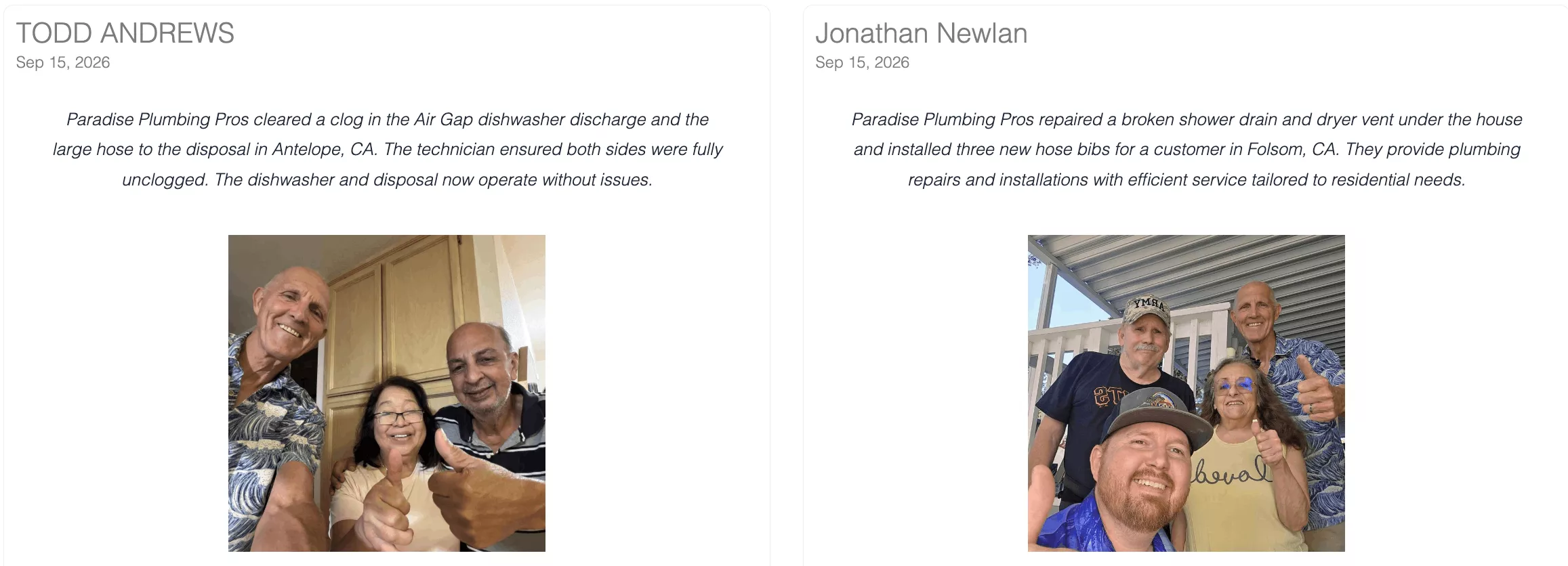
Displaying a plumbing license number, award badges, and original photos of trucks and staff, rather than stock imagery, gives visitors specific, verifiable signals of trust rather than a general claim of quality.
Showcasing recent plumbing jobs, including images and descriptions of each job, can also strengthen a prospective customer’s perception of your business.
Reduce Friction on Contact Forms
Contact forms with more than three fields see fewer completions than shorter forms, since each additional field gives a visitor another reason to abandon the form before submitting.
Adding fields intentionally increases friction, which some plumbing companies use to filter for higher-quality leads at the cost of losing some qualified visitors along the way.
Businesses relying primarily on organic SEO traffic, which tends to arrive already qualified, generally benefit from shorter forms with less filtering built in.
Embed Video Content
Embedding video on plumbing website pages gives visitors a faster way to evaluate a business than reading text alone, and video content is eligible to rank directly in Google search results, creating an additional traffic source beyond the webpage itself.
A plumbing company can produce useful video content with a smartphone and basic editing software, including a staff introduction video and short videos for each core service offered.
Showcase Unique Value Propositions (UVPs)
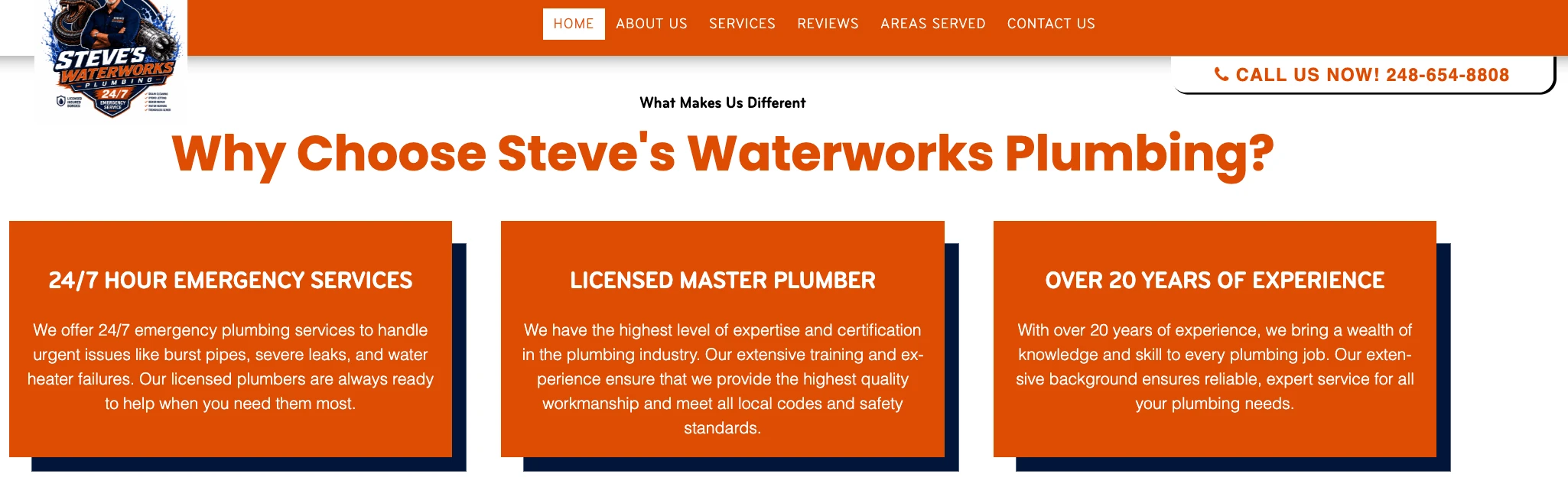
Visitors who see a plumbing company as generic or interchangeable with competitors are less likely to convert. Unique value propositions help a website stand out:
- Local Expertise
- Real-Time Trust Signals
- Fast and Easy Scheduling
- Emergency Readiness
- Transparent Pricing
- Licensed and Insured Plumbers
- Eco-Friendly Solutions
Prioritize User Experience
Poor user experience can suppress conversions, even on a website with strong CTAs and UVPs. Navigation across desktop, mobile, and tablet devices directly affects conversion rates, since a visitor who struggles to find information will leave before converting, no matter how compelling that information is.
Plumbing website design should prioritize ease of navigation over visual complexity, since usability matters more than aesthetics when it comes a conversion.
Closing: What Conversion Rate Optimization Changes
Driving visitors to a plumbing website through organic search, Google Maps, and AI platforms only produces value if that traffic converts at an acceptable rate.
A website with strong technical CRO fundamentals in place, meaning fast load times, clear CTAs, verifiable trust signals, and consistent tracking, converts a higher share of the same traffic than one without them.
CRO does not replace a plumbing business’s underlying reputation, service quality, or pricing structure. It ensures that the traffic a plumbing business already earns has the best possible chance of becoming a lead.

Author: Nolen Walker
Nolen Walker is the founder of Plumbing Webmasters and the creator of DataPins™, a Local SEO platform for plumbing companies. He has over 16 years of experience helping plumbing businesses grow through organic search, Google Maps, and AI-driven visibility.
Nolen is the author of A Complete SEO Guide for the Plumbing Small Business Owner. He also hosts The Plumbing SEO Podcast on Spotify.